March 23, 2026
If you’ve spent any time researching commercial cannabis lighting, you’ve probably come across the term DLI. It gets mentioned in the same breath as PPFD and PPF, and like those metrics, it’s easy to nod along without fully understanding what it actually means or why it should influence how you design and run your lighting program.
DLI is one of those concepts that once you understand it, changes how you think about lighting decisions entirely. Because while PPFD tells you how hard your lights are working at any given moment, DLI tells you something more useful: how much light your plants actually received over the course of a full day.
The Simple Version
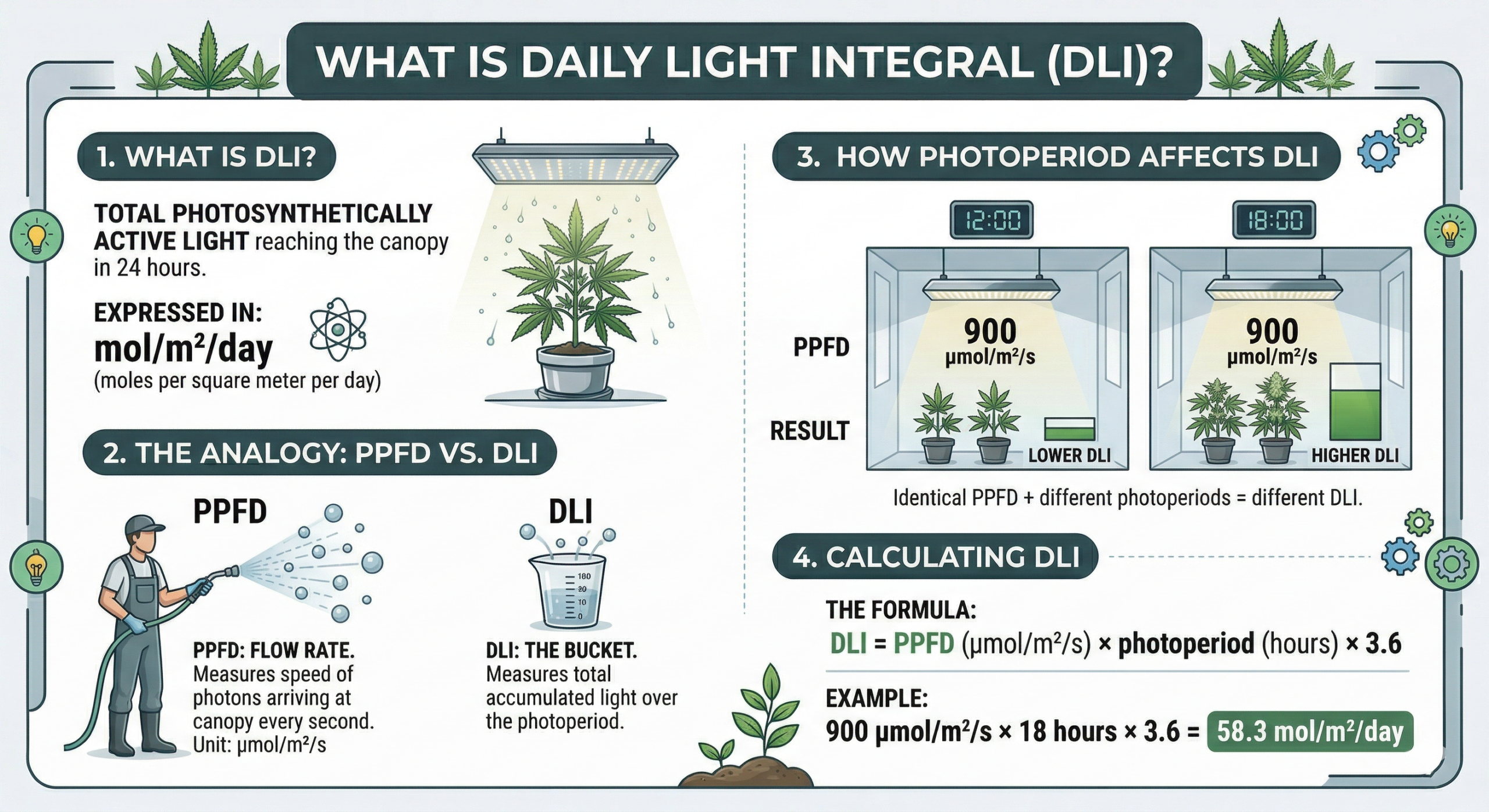
Daily Light Integral is the total amount of photosynthetically active light that reaches your canopy over a 24-hour period. It’s expressed in moles of light per square meter per day, written as mol/m²/day.
PPFD is like the flow rate of water coming out of a hose. It tells you how fast photons are arriving at the canopy surface at any given second. DLI is the bucket you’re filling. It measures how much total light accumulates over the entire photoperiod.
Two grow rooms with identical PPFD readings can end up with very different DLI values if they run different photoperiods. A room running at 900 µmol/m²/s for 12 hours will accumulate a different DLI than one running the same intensity for 18 hours. And a room where fixtures are dimmed for parts of the day is delivering less total light than the instantaneous reading suggests.
The formula is straightforward:
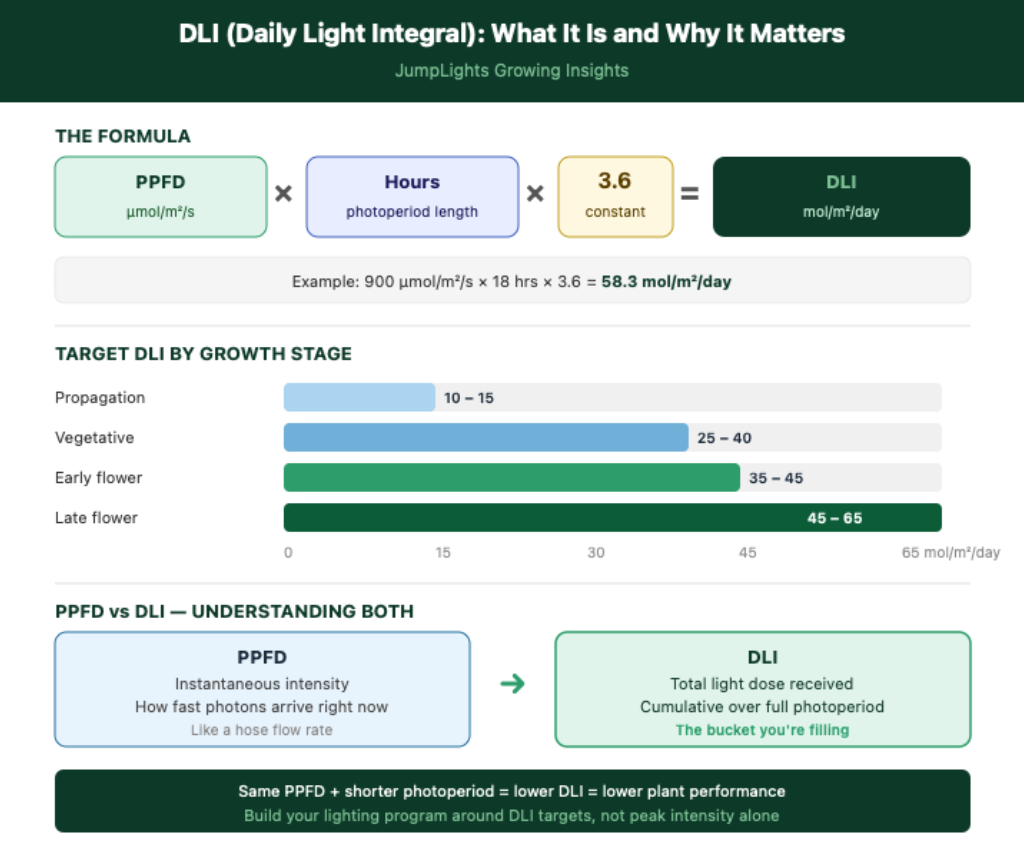
DLI = PPFD (µmol/m²/s) × photoperiod (hours) × 3.6
So a room running at 900 µmol/m²/s for 18 hours would have a DLI of: 900 × 18 × 3.6 = 58.3 mol/m²/day.
Why DLI Matters More Than Instant PPFD Alone
Here’s where the concept pays off practically. Cannabis is a high-light crop, and its productivity is closely tied to the cumulative light dose it receives, not just the peak intensity. Two facilities with very different PPFD readings can end up delivering similar DLI values depending on how they manage their photoperiods and dimming schedules. And two facilities with similar PPFD readings can deliver drastically different DLI values for the same reasons.
This matters because plants don’t experience light as a snapshot, they integrate it over time. The biochemical processes that drive growth and flower development respond to the total light energy available throughout the day, not just the intensity at noon or at any single measurement point.
Research on cannabis grown under high light conditions consistently shows that yield scales with cumulative light delivery up to a point. Understanding DLI is how you quantify that delivery and compare it meaningfully across different rooms, different fixture types, and different management strategies.
It’s also one of the most useful diagnostic tools available when a grow room isn’t performing as expected. Growers who troubleshoot by checking PPFD under the fixture often miss the fact that their actual DLI is low because fixtures are being dimmed during warm periods of the day, or because the photoperiod was shortened without accounting for the yield impact.
Target DLI Values for Cannabis
While the right DLI for any specific operation depends on genetics, CO2 levels, temperature management, and other environmental factors, research and commercial experience have established some useful benchmarks.
For vegetative cannabis, most commercial operations target a DLI in the range of 25–40 mol/m²/day. Plants at this stage are building structure, and they respond well to consistent, moderately high light without the same demand for peak intensity that flower requires.
For flowering cannabis, the target range moves higher, typically 35–55 mol/m²/day for well-managed operations, with some high-performance facilities pushing into the 55–65 mol/m²/day range when CO2 supplementation, temperature, and nutrition are dialed in to support it. As we’ve covered before, more light isn’t automatically better, the plant has to be in a position to use it. But for operations that have the rest of their environment under control, higher DLI tends to produce proportionally higher yields.
Below 30 mol/m²/day in flower, most cannabis genetics will show the classic signs of insufficient light: loose, airy bud structure, extended development timelines, and yields that fall short of what the genetics are capable of delivering.
Get a FREE Light Plan + Growing Tips!
How DLI Connects to Fixture Selection and Layout
Understanding DLI changes how you evaluate lighting equipment and how you approach room design.
When you’re comparing fixtures, PPE (photosynthetic photon efficacy) measured in µmol/J, tells you how efficiently a fixture converts electricity into usable light. But DLI gives you a way to think about the total energy investment required to hit your cultivation targets. A more efficient fixture reaches your target DLI at lower operating cost. A less efficient fixture may achieve the same DLI, but you’re paying more per mol delivered, every single day, across every cycle.
Fixture efficiency and the numbers behind it become very concrete when you frame them through DLI. If you’re targeting 45 mol/m²/day across a 10,000 square foot facility running 12-hour flower cycles, the difference between a 2.5 µmol/J fixture and a 3.0 µmol/J fixture is measurable in thousands of dollars per year in electricity alone.
Layout matters too. A room where overhead fixtures deliver good average PPFD but with significant variation across the canopy will have zones where the local DLI falls well below your target, even when the room average looks acceptable. This is exactly the relationship between DLI and uniformity: a PPFD hotspot directly under a fixture might be accumulating an excess DLI that contributes to light stress, while a shadowed area two feet away is starved for light. Average DLI across the room can look fine while meaningful portions of your canopy are over- or under-lit.
Putting DLI to Work in Your Operation
The most practical thing you can do with this concept is start calculating the DLI your rooms are actually delivering rather than estimating from PPFD alone.
Take your average PPFD reading across the canopy and multiply it by your photoperiod hours and 3.6. If the number is below your target range for the growth stage, you have three levers to adjust: intensity, photoperiod, or both. In flower, where the photoperiod is fixed at 12 hours for most genetics, intensity and uniformity are where the work happens. In veg, extending the photoperiod is often the simpler path to hitting a higher DLI without increasing fixture intensity.
DLI also gives you a consistent unit of comparison when evaluating different lighting configurations, making it easier to have productive conversations with lighting suppliers, or to verify that a proposed design will actually deliver what your cultivation program requires.
Final Thoughts
PPFD tells you what your lights are capable of. DLI tells you what your plants actually received. For commercial cannabis operations optimizing yield and quality across multiple cycles per year, that distinction matters more than it might seem at first glance.
Build your lighting program around DLI targets, and the decisions about which fixtures to buy, how to lay them out, and how to manage your photoperiod all become more grounded in what the plant actually needs.
If you’d like help modeling the DLI your current setup delivers, or designing a new room around a specific target, our team is happy to work through it with you.
JumpLights designs and manufactures high-efficiency LED grow lights for commercial cannabis and horticulture facilities. All products are engineered, assembled, and quality-tested in the USA.
Disclaimer
The content appearing on this webpage is for informational purposes only. JumpLights makes no representation or warranty of any kind, be it expressed or implied, as to the accuracy, completeness, or validity of the information. Any performance parameters, specific design features, or discussions of lighting fixtures or specs should not be inferred to represent what will be delivered for your specific project. Consult the JumpLights terms of service for more information.