March 20, 2026
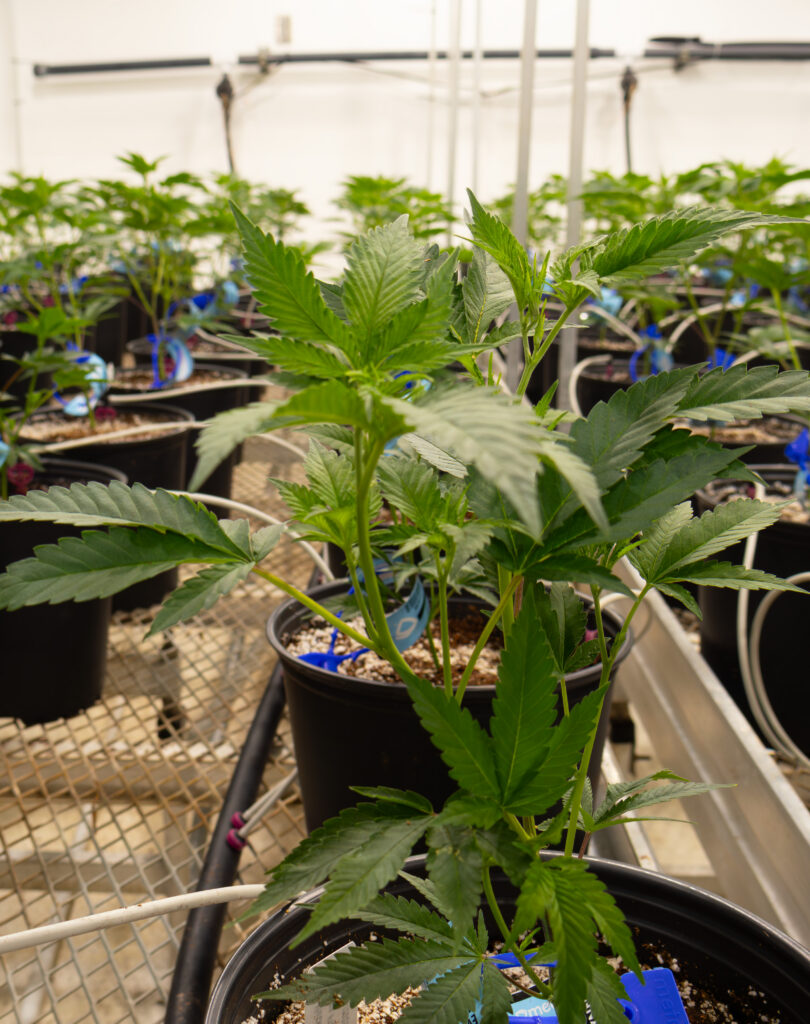
Most growers understand that cannabis is a hungry crop. It needs a steady, well-timed supply of nutrients to develop properly, and when that supply is off, the plants show it. What’s less obvious is how much the delivery method matters.
Fertigation, the practice of delivering nutrients through your irrigation water rather than as a separate feeding, has become the standard approach in commercial cannabis cultivation for good reason. In our experience at JumpLights, when it’s done well, it gives you precise control over what your plants receive and when. Done poorly, it creates the same problems it was supposed to solve: nutrient imbalances, stressed plants, and inconsistent harvests.
Here’s what you actually need to understand to get it right.
What Fertigation Is and What It Isn’t
At its most basic level, fertigation is just mixing soluble nutrients into your irrigation water and delivering them to the root zone together. That might sound simple, but the real value is in the precision it enables.
Instead of top-dressing nutrients on a schedule and hoping they move through the medium consistently, fertigation lets you dial in the exact concentration reaching the roots at any given time. You control the EC (electrical conductivity, a measure of total dissolved nutrient concentration), the pH, and the timing of delivery. That level of control isn’t really possible with dry feeding or hand watering at scale.
It’s worth being clear about what fertigation isn’t, though. It’s not a set-it-and-forget-it system. The precision it offers only pays off if you’re monitoring what’s happening in the root zone and adjusting accordingly. A well-designed fertigation system that nobody is watching closely will drift, and when it does, the plants respond before your sensors do.
The Fundamentals: EC, pH, and Timing
These three variables drive most of what happens in a fertigation program, and they interact with each other in ways that matter.
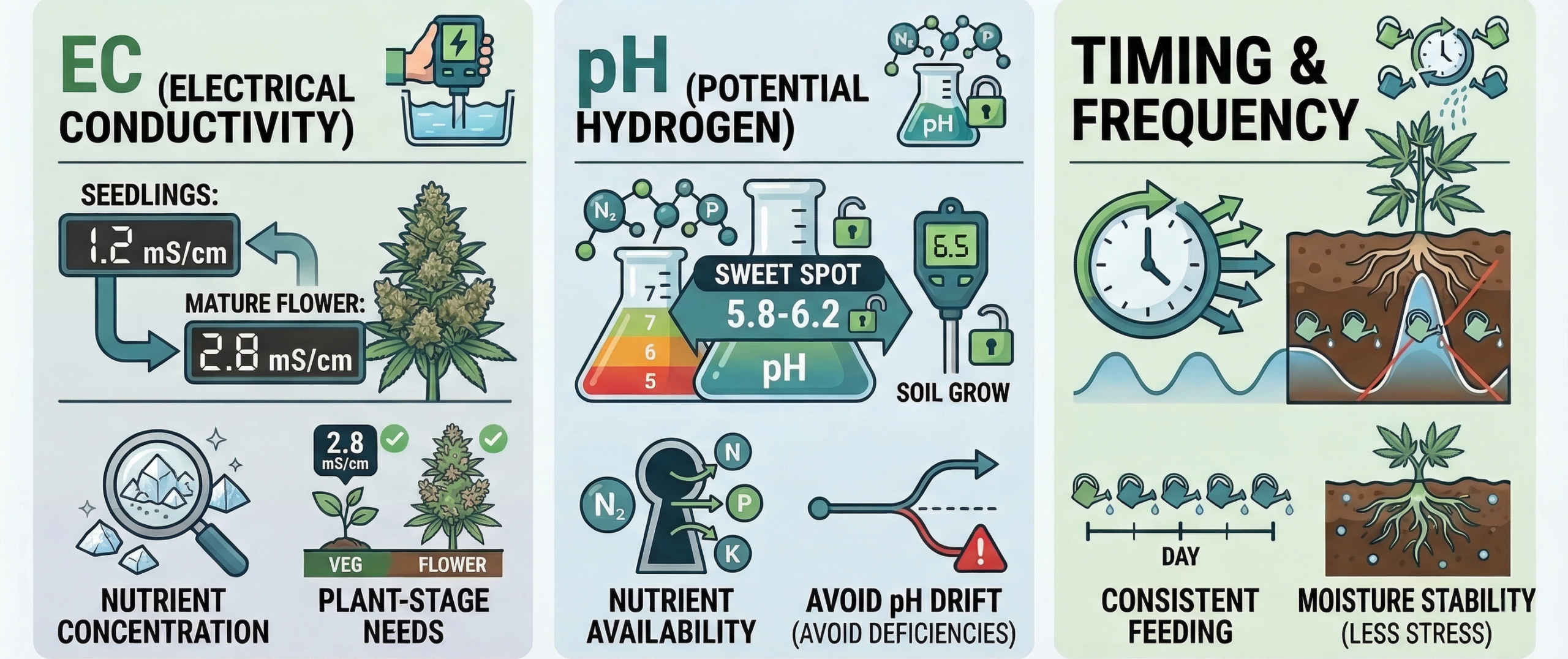
EC tells you how concentrated your nutrient solution is. Cannabis has different EC tolerances at different growth stages: seedlings and young plants are sensitive to high concentrations, while mature plants in peak flower can handle and benefit from higher EC. A general range for established vegetative plants is around 1.2–2.0 mS/cm, moving toward 2.0–2.8 mS/cm in mid-to-late flower, though your specific genetics, medium, and environmental conditions will influence where the optimal range actually sits for your facility.
pH determines which nutrients are available to the plant. Cannabis roots absorb different elements most efficiently at different pH levels, and a solution that’s out of range can lock out nutrients that are technically present. For most soilless or coco-based grows, a pH of 5.8–6.2 is a good sweet spot. Soil grows tolerate a slightly wider range, up to 6.5. Small deviations compound over time, which is why pH drift is one of the more common sources of deficiencies that growers initially misread as a nutrient problem.
Timing and frequency are where a lot of growers leave performance on the table. The goal is to maintain consistent moisture and nutrient availability in the root zone, not to flood and then let the medium dry out completely between feeds. High-frequency fertigation, delivering smaller volumes more often, keeps conditions stable and reduces the peaks and valleys that stress roots. In coco and other fast-draining media, multiple short fertigation events per day during lights-on periods is common in high-performance commercial operations.
Matching Nutrients to Growth Stage
Cannabis has meaningfully different nutritional needs across its life cycle, and a fertigation program that doesn’t account for that is working against the plant.
During vegetative growth, nitrogen drives leaf and stem development. Plants at this stage are building the structure they’ll need to support flower production, so a nutrient profile heavier in nitrogen relative to phosphorus and potassium makes sense. As plants transition to flower, that ratio shifts. Phosphorus supports root development and energy transfer during early flower, and potassium becomes increasingly important as buds develop and density builds.
In late flower, many growers reduce nitrogen deliberately (a practice sometimes called a “fade”) to encourage the plant to draw down stored nutrients and improve the final flavor and aroma profile of the flower. How aggressively you do this depends on your genetics and your target product, but it’s a well-established practice in quality-focused operations.
It’s also worth knowing that light intensity directly affects how much your plants can absorb. Higher light levels drive faster photosynthesis, which in turn increases the plant’s demand for water, CO2, and nutrients. If you’ve recently increased your light intensity and you’re seeing what looks like deficiencies, your fertigation program may simply need to catch up to the new growth rate.
Runoff Monitoring: Don’t Skip It
In any medium that produces runoff (like coco, rockwool, perlite blends) measuring the EC and pH of what comes out of the bottom of your containers is one of the most useful feedback tools available.
Runoff EC that’s significantly higher than what you’re putting in tells you that salts are accumulating in the medium. That buildup restricts water uptake and can push the plant into effective deficiency even when your input solution looks right. Runoff EC that’s much lower than your input means the medium may be too dry and the plants are consuming nutrients faster than you’re replacing them.
Neither of these situations is a crisis if you catch it early. Both become harder to manage the longer they go unaddressed. VPD and environmental conditions also influence how aggressively plants are taking up water, which means your runoff readings can shift seasonally or any time your room conditions change significantly.
A Note on Water Quality
Source water composition matters more than most growers realize when they’re starting out. High baseline EC from dissolved minerals, chlorine or chloramine additions, or significant calcium and magnesium levels in your source water all affect how you formulate your nutrient solution.
If your source water has an EC above 0.4–0.5 mS/cm, that baseline is already occupying part of your plant’s tolerance range before you’ve added a single nutrient. Reverse osmosis filtration gives you a clean starting point and more predictable outcomes, particularly if you’re troubleshooting persistent deficiencies that don’t respond to obvious fixes.
How Fertigation Connects to Your Lighting Program
There’s a direct relationship between how hard your lights are pushing your plants and how much your fertigation program needs to deliver. Commercial cannabis grown under high light intensity has proportionally higher demands for water and nutrients, and a fertigation program calibrated for lower-light conditions will underperform when you increase your PPFD.
This is one of the reasons lighting upgrades and cultivation system reviews tend to happen together. It’s not just that better lights produce more photons… It’s that your plants’ entire metabolism shifts when their light environment changes, and your feeding program needs to reflect that.
Final Thoughts
Fertigation gives you more control over your cannabis crop than almost any other single system in the facility. That control is valuable, but it requires attention, monitoring, and a willingness to adjust when the plants tell you something isn’t right.
Get your EC and pH dialed in, feed in alignment with the growth stage, watch your runoff, and understand how your light program and your fertigation program influence each other. Those fundamentals, applied consistently, will take you further than any proprietary nutrient line or complicated feeding schedule.
If you’re evaluating how your lighting setup is affecting plant performance and nutrient demand, our team is happy to help. Get a free light plan and we’ll work through what your canopy actually needs.

JumpLights designs and manufactures high-efficiency LED grow lights for commercial cannabis and horticulture facilities. All products are engineered, assembled, and quality-tested in the USA.
Disclaimer
The content appearing on this webpage is for informational purposes only. JumpLights makes no representation or warranty of any kind, be it expressed or implied, as to the accuracy, completeness, or validity of the information. Any performance parameters, specific design features, or discussions of lighting fixtures or specs should not be inferred to represent what will be delivered for your specific project. Consult the JumpLights terms of service for more information.