April 22, 2026
Why Photobleaching Happens and How to Prevent It Without Lowering Light
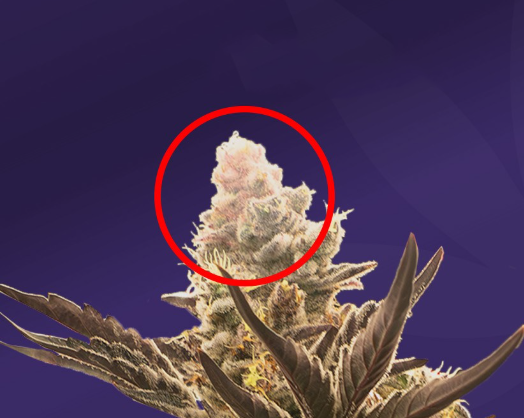
You’ve pushed your lights hard, your canopy looks lush, and then you see it. The top colas are turning white. Not frosty with trichomes. Just white. That’s photobleaching, and it’s one of the most frustrating problems growers face when chasing high yields under intense light.
The knee-jerk reaction is to dim your lights. But that’s the wrong answer. Our core philosophy is that high PPFD and high daily light integrals (DLI) are what drive yield, and the science backs us up. The solution to photobleaching isn’t less light. It’s smarter light.
What exactly is photobleaching?
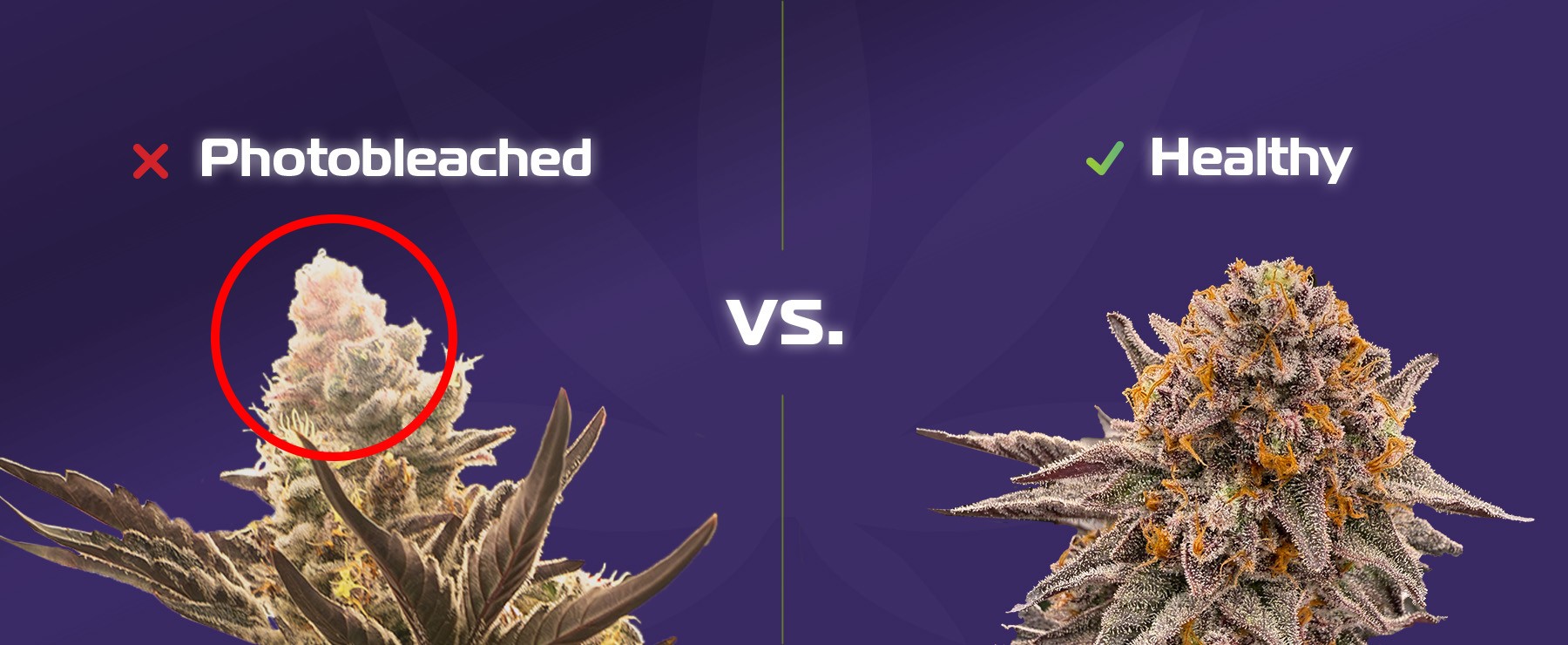
Photobleaching is the destruction of chlorophyll in plant tissues caused by excess light energy—specifically, more energy than the plant’s photosynthetic machinery can safely process. Visually, it presents as white or cream-colored flower tissue at the top of the canopy, where light intensity is highest.
At the cellular level, the problem begins inside Photosystem II (PSII). Under intense light, the antenna complexes that harvest photons can absorb energy faster than the electron transport chain can move it along. (Lambrev et al., Frontiers in Plant Science, 2020) This creates a dangerous backlog of reactive oxygen species (ROS), highly reactive molecules that essentially burn through chlorophyll structure. When chlorophyll is destroyed, plant tissue loses its green color, leaving behind bleached-white floral bud.
Key insight: Photobleaching is fundamentally a mismatch between incoming light energy and the plant’s capacity to use it, not simply a matter of “too much light.” That distinction matters enormously when choosing your solution.
It’s worth noting that in most cases, photobleaching is primarily a cosmetic and marketability problem. Research suggests it doesn’t necessarily destroy terpenes, cannibinoids, or yield potential in the broader canopy, the damage is concentrated in the bleached floral tissue at the very top. But in a competitive market where shelf appeal matters, bleached buds that look brown when dried are difficult to sell at a premium. Your best-looking tops are often your highest-value product. Protecting them protects your bottom line.
The spectrum is the hidden variable
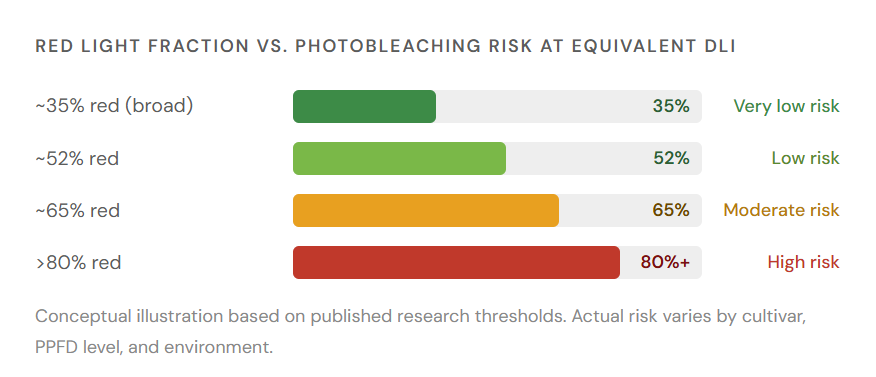
Here’s the critical insight that most discussions about photobleaching miss: it’s not just about total light intensity. It’s about the spectral composition of that light, specifically, how much of it is red.
Red wavelengths (around 630–670 nm) are strongly absorbed by chlorophyll a and b, the primary light-harvesting pigments. (Eichhorn Bilodeau et al., Frontiers in Plant Science, 2019; Morrow, 2008) When a fixture delivers a spectrum that is heavily weighted toward red, the plant’s photosystems are being hit with high-energy, efficiently absorbed photons across the entire light dose. That’s a recipe for PSII overload—even at intensities that would be perfectly safe under a broader spectrum.
Published research has demonstrated that exceeding a daily red light integral of approximately 20 mol/m²/d is strongly associated with photobleaching in cannabis. (Llewellyn et al., Frontiers in Plant Science, 2022) To understand why this threshold matters, consider the math: a fixture delivering 50% red at a DLI of 40 mol/m²/d hits exactly 20 mol/m²/d of red light. The same DLI under an 80%-red fixture would reach that threshold at only 25 mol/m²/d—a significant difference in how much total light you can deliver before risk increases.
A 2024 peer-reviewed study in Industrial Crops and Products found that high-white LED spectra with lower red fractions allowed cannabis to achieve strong inflorescence yield and specialized metabolite production—including cannabinoids and terpenoids—across a range of intensities. (van Veldhuisen et al., ScienceDirect, 2024) In other words, the broad-spectrum approach doesn’t just protect against photobleaching—it also supports the plant’s full productive potential.
Why turning down the lights is the wrong answer
Let’s be direct: dimming your lights to avoid photobleaching is a costly compromise. Cannabis is a high-light crop with an exceptional capacity to convert photons into biomass, far exceeding most other crops grown in controlled environments.
Research published in Frontiers in Plant Science demonstrated a proportional increase in flower yield as PPFD increased from 600 to 1,000 μmol/m²/s, with no plateau reached at the top of the tested range. (Llewellyn et al., Frontiers in Plant Science, 2022) A separate review confirms that cannabis yield responses continue to increase almost linearly at DLIs well beyond what full summer sunlight would deliver outdoors, up to 100 mol/m²/d in some cases. (Nielsen, cited in “Using High Light Levels,” jumplights.com, 2024)
Cannabis stands apart from many crops in this respect. Lettuce and basil typically reach their yield ceiling between 250 and 600 μmol/m²/s. Cannabis keeps climbing. That capacity is a gift and sacrificing it by dimming your lights because of a spectrum problem means leaving real money on the table.
The JumpLights principle: High intensity growing and quality flower are not in conflict. They require a sophisticated approach to spectrum, not a compromise on light output. Every photon you pull back to compensate for a poorly matched spectrum is yield you’ll never recover.
The role of genetics and what to watch for
Cultivar genetics play a real role in photobleaching susceptibility. Some varieties tolerate very high red fractions and intensities without issue; others bleach well below published thresholds even under apparently ideal conditions. This variability is documented in the literature and observed consistently in commercial grows. (Llewellyn et al., Frontiers in Plant Science, 2022)
When you introduce a new cultivar into your operation, treat its light tolerance as an unknown until you’ve characterized it. Early signs of photobleaching often appear as subtle pallor or pale tips at the upper inflorescences before full bleaching sets in, catching the issue at this stage gives you time to adjust spectrum or canopy positioning without affecting your whole crop.
Under-canopy lighting: a special consideration
Under canopy lighting dramatically improves yield and harvest index… academic research and our own customers’ results make this clear. Distributing light throughout the canopy, rather than relying solely on top-down illumination, helps address the natural light penetration limitations of cannabis’s predominantly horizontal leaf architecture. (Nielsen, cited in “Using High Light Levels,” jumplights.com, 2024)
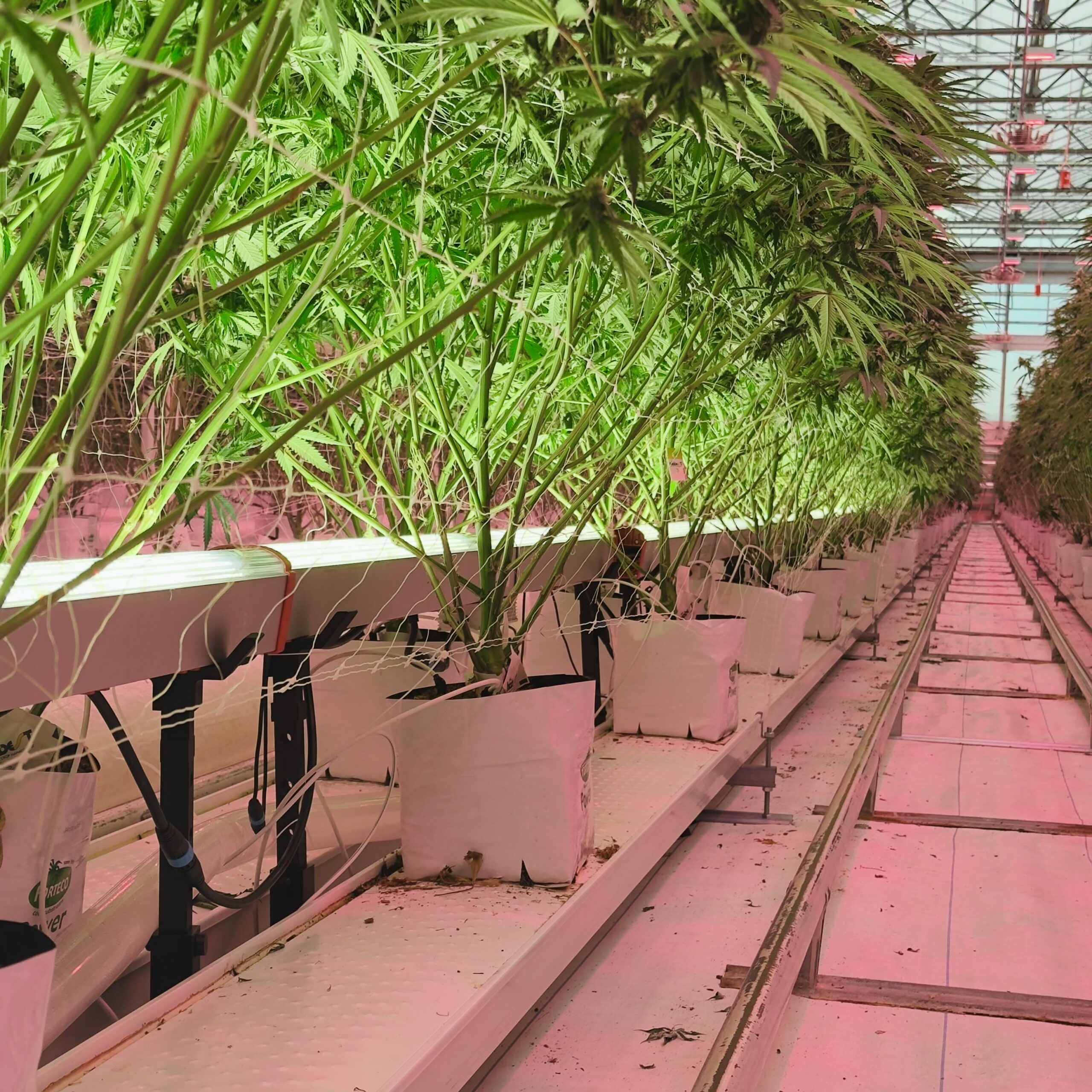
But under-canopy placement creates a unique photobleaching challenge. Your lights are physically close to plant tissue, and there’s a hard limit to how far you can position them away. That geometry means spectrum choice becomes even more critical in this context. Red-heavy spectra that might be tolerable overhead can easily tip over the photobleaching threshold when applied at close range from below.
That’s why JumpLights’ Catalyst Pro under-canopy lights are engineered with broad-spectrum options (specifically our 35% and 52% red configurations) chosen precisely because they deliver meaningful light intensity without crossing into the spectral territory where photobleaching risk climbs. The Catalyst Pro is also built to survive the demanding under-canopy environment: durable enough to handle humidity and physical contact, and designed to mount on racks or trellis bars so it doesn’t need to be moved during changeovers.
Environmental factors that amplify the problem
Light spectrum and intensity are the primary drivers of photobleaching, but environmental conditions can worsen or improve a plant’s ability to manage incoming light energy. Temperature is a notable factor: preliminary research in other crops suggests that elevated temperatures may exacerbate photobleaching, possibly by affecting the stability of photosystem proteins and the efficiency of protective dissipation mechanisms.
This means your HVAC system isn’t just about plant comfort—it’s part of your photobleaching management strategy. Maintaining appropriate canopy temperatures, particularly in high-intensity environments, reduces one more stressor from an already-loaded photosynthetic system.
Light distribution uniformity also matters. Hotspots create localized conditions where bleaching can occur even when average PPFD readings look acceptable. Using fixtures with well-characterized beam patterns and appropriate spacing can smooth out these peaks before they become a problem.
A framework for prevention without sacrifice
Putting this together, here’s how to approach photobleaching prevention in a way that protects your crop without surrendering yield:
1. Choose the right spectrum for your application
For over-canopy lighting, a broad-spectrum fixture with a red fraction in the 30–65% range gives you the flexibility to push intensity while staying well below photobleaching thresholds for most cultivars. JumpLights Budkicker over-canopy lights offer red options from 30% to 80%, allowing you to dial in the precise balance your cultivars and facility require.
2. Be especially conservative under the canopy
Under canopy placement demands a more cautious spectral approach. The 35% and 52% red options on JumpLights Catalyst Pro lights reflect our confidence that these spectra maximize under-canopy yield contribution without putting your flowers at risk.
3. Know your cultivars before you push them
New genetics should be characterized before running at maximum intensity. Start at moderate PPFD, monitor upper inflorescences closely during the first two to three weeks of flower, and scale intensity with confidence once you’ve confirmed the cultivar’s tolerance.
4. Manage your environment alongside your lights
Keep canopy temperatures in an appropriate range, ensure good air circulation, and use uniform light distribution to avoid intensity hotspots. These factors don’t replace good spectrum choices, but they reduce the margin for error.
5. Track your daily red light integral, not just total DLI
Total DLI is a useful metric, but the red component of your DLI matters independently. If you know your fixture’s red fraction, multiply it by your total DLI to estimate your daily red light integral. Staying below roughly 20 mol/m²/d of red light significantly reduces your photobleaching exposure.
The bottom line
Photobleaching is a spectrum problem wearing the costume of an intensity problem. Growers who treat it by dimming their lights are paying a real yield penalty to solve the wrong issue.
At JumpLights, we believe the path to more grams per watt runs through smarter spectrum engineering, not compromise on light output. Our mission is to help you produce more high-quality flower, and that means giving you the spectral flexibility to push intensity as hard as your cultivars, facility, and infrastructure will allow.
If you’re seeing early signs of photobleaching in your facility or if you want to design a lighting strategy from the ground up that maximizes intensity without risk, reach out to our team at jumplights.com. Every facility is different, and we’ll work with you to find the right fit.
References & Further Reading
-
- Lambrev, P. H., et al. (2020). “Photobleaching of Chlorophyll in Light-Harvesting Complex II Increases in Lipid Environment.” Frontiers in Plant Science, 11, 849. doi:10.3389/fpls.2020.00849
- Llewellyn, D., et al. (2022). “Indoor grown cannabis yield increased proportionally with light intensity, but ultraviolet radiation did not affect yield or cannabinoid content.” Frontiers in Plant Science, 13. doi:10.3389/fpls.2022.974018
- van Veldhuisen, B., et al. (2024). “High light intensity improves yield of specialized metabolites in medicinal cannabis.” Industrial Crops and Products. ScienceDirect
- Eichhorn Bilodeau, S., et al. (2019). “The role of red and white light in optimizing growth and accumulation of plant specialized metabolites in medical cannabis.” Frontiers in Plant Science. doi:10.3389/fpls.2024.1393803
- Chandra, S., et al. (2008). Photosynthetic response of Cannabis sativa to variations in photosynthetic photon flux densities.
- Rodriguez-Morrison, V., Llewellyn, D., & Zheng, Y. (2021). “Cannabis Yield, Potency, and Leaf Photosynthesis Respond Differently to Increasing Light Levels in an Indoor Environment.” Frontiers in Plant Science.
- JumpLights. (2024). “Using High Light Levels: Yield and Energy Use of Indoor Grown Cannabis.” jumplights.com
JumpLights designs and manufactures high-efficiency LED grow lights for commercial cannabis and horticulture facilities. All products are engineered, assembled, and quality-tested in the USA.
Disclaimer
The content appearing on this webpage is for informational purposes only. JumpLights makes no representation or warranty of any kind, be it expressed or implied, as to the accuracy, completeness, or validity of the information. Any performance parameters, specific design features, or discussions of lighting fixtures or specs should not be inferred to represent what will be delivered for your specific project. Consult the JumpLights terms of service for more information.