March 20, 2026
There’s a lot of conversation in commercial cannabis about the risks of too much light on plants. These include photobleaching, light burn, and stressed plants that stop responding the way they should. Those are real concerns that are worth understanding. But the quieter, more common problem in many commercial facilities is the opposite: not enough light.
Low lighting levels don’t announce themselves the way other problems do. There’s no sudden visual cue, no obvious damage to point to. What you get instead is a slow drain on performance. This can include yields that are lower than they should be, flower that doesn’t quite hit the density or potency you’re aiming for, and a nagging sense that your genetics are capable of more than they’re producing.
Understanding what low light actually does to a cannabis plant (and how to recognize it) is one of the more practical things a commercial grower can do to close the gap between what they’re getting and what’s possible.
How Cannabis Responds to Light at a Biological Level
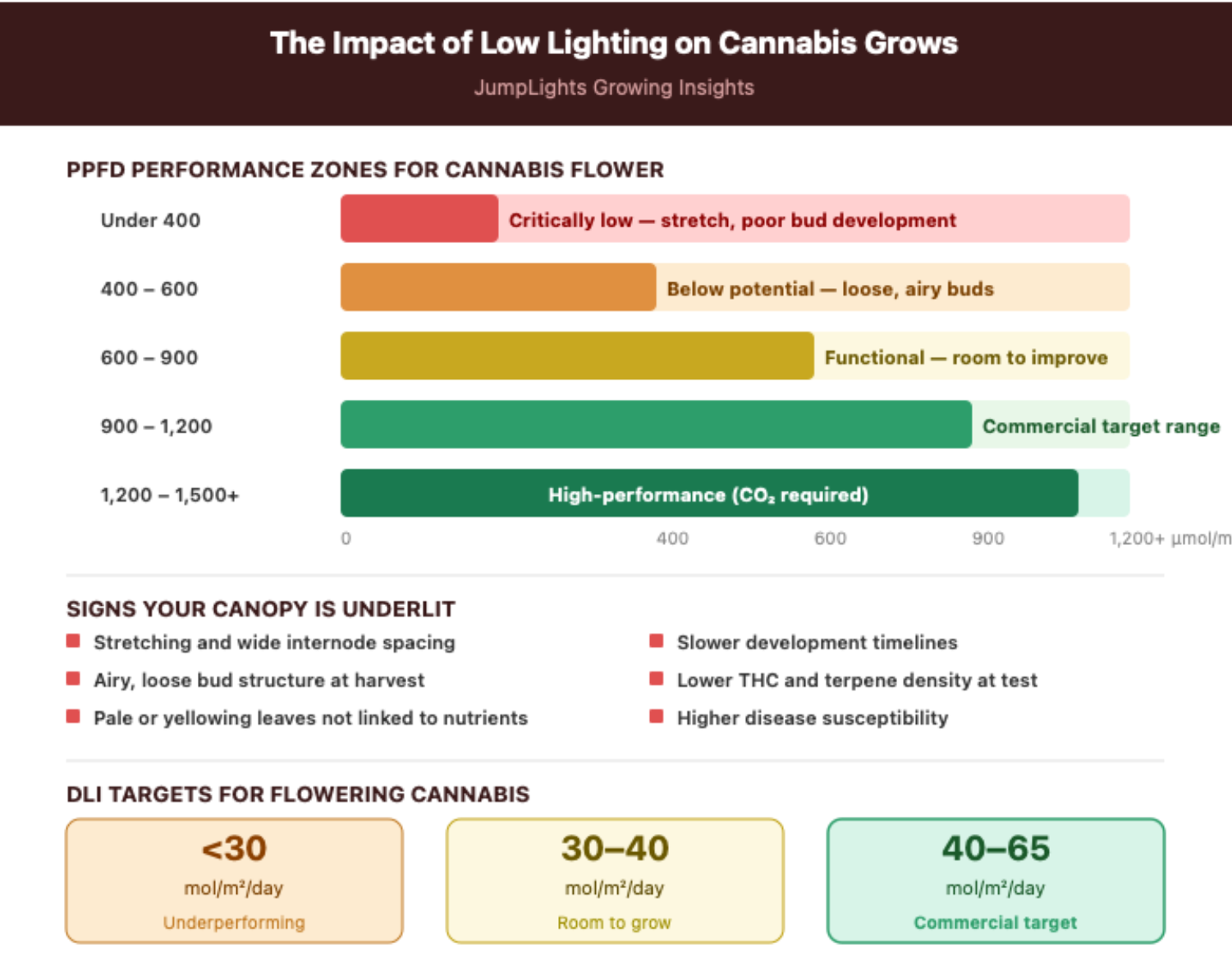
Cannabis is what researchers classify as a high-light crop. It has a relatively high light saturation point, meaning it can continue to increase photosynthesis in response to more light well beyond what many other crops can handle. Under the right conditions, commercial cannabis responds productively to PPFD levels of 800 µmol/m²/s and above, with well-managed high-light programs pushing into the 1,200–1,500 µmol/m²/s range during peak flower.
When light falls well below those thresholds, photosynthesis slows. The plant produces less sugar through the Calvin cycle, which means less energy available for growth, flower development, and the synthesis of cannabinoids and terpenes. The plant is alive and functional; it’s just running at a fraction of its potential.
This relationship between light and yield isn’t linear, but it is consistent. Research on high-light cannabis cultivation has repeatedly shown that increasing PPFD from moderate to high levels produces measurable gains in both yield and potency; not because the plants are being pushed beyond their limits, but because they’re finally being given enough to operate near them.
What Are the Effects of Low Light on Cannabis Plants?
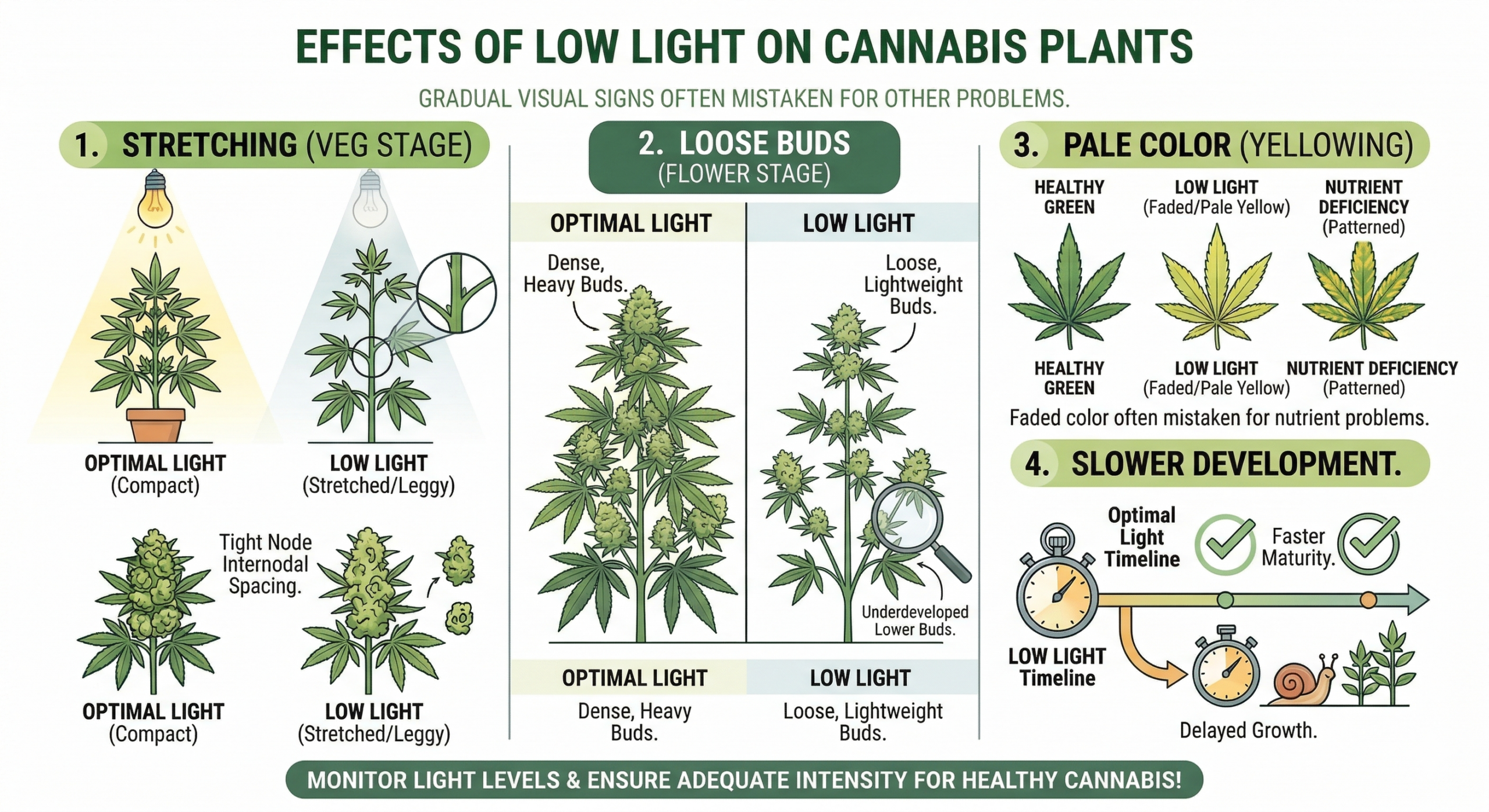
The visual signs of insufficient light are gradual and easy to mistake for other issues.
Stretching and loose structure are among the earliest indicators. When cannabis doesn’t receive enough light, it responds by elongating internodal spacing, essentially reaching upward in search of more light. In veg, this shows up as tall, leggy plants with wider gaps between nodes. In flower, it means buds that develop loosely, with more space between calyxes than a well-lit plant would produce. The result is lower density and lower weight at harvest.
Airy, underdeveloped buds at the lower canopy are another tell. Even in rooms where overhead lighting is adequate at the top of the canopy, the lower third of the plant often sits in significantly reduced light. Those lower bud sites can photosynthesize enough to survive, but not enough to thrive. Growers sometimes attribute this to genetics or to not defoliating aggressively enough, but the light environment is often the primary driver.
Pale or faded coloring, particularly yellowing that doesn’t respond to nutrient adjustments, can sometimes trace back to low light rather than a deficiency. Plants that aren’t photosynthesizing actively don’t demand as many nutrients, which changes how they present visually in ways that can mimic other problems.
Slower development timelines are harder to notice in real time but become visible in your harvest data. Plants under low light take longer to reach the same developmental milestones, which compresses the number of cycles you can run annually and reduces the output per square foot per year.
The DLI Problem: It’s Not Just About Intensity
One thing that often gets missed in conversations about lighting levels is the concept of Daily Light Integral (DLI) which measures the total amount of light a plant receives over the course of a full photoperiod, not just the instantaneous intensity.
You can have a room where the peak PPFD reading looks acceptable but the DLI is too low because the photoperiod is too short, or because the fixtures are dimmed during parts of the day, or because plants are spending portions of their light cycle in lower-intensity zones due to uneven distribution. All of these scenarios reduce the cumulative light dose the plant receives, with effects similar to simply running lower-intensity fixtures.
For flowering cannabis, a DLI in the range of 35–45 mol/m²/day is often cited as a target for high-performance production. Facilities running well below that range, even if they don’t recognize it as a lighting problem, are leaving yield on the table. Light spectrum also plays a role here: delivering the right DLI matters more when the spectrum is well-matched to what the plant can actually use.
Low Light and Disease Pressure
There’s a less obvious consequence of low lighting that commercial growers deal with more often than they probably realize: weakened plants are more susceptible to disease.
Cannabis grown under insufficient light tends to develop less robust tissue including thinner cell walls, less physical resilience, reduced production of the secondary metabolites that help plants defend themselves. That vulnerability shows up as a higher incidence of powdery mildew, botrytis, and other pathogens that a healthier, better-lit plant might resist more effectively. If your facility is dealing with recurring disease pressure despite good environmental controls, the baseline health of your plants is worth examining.
Recognizing the Gap in Your Own Facility
The most practical first step for any commercial grower who suspects low light might be limiting their results is to do a proper PPFD map of their space. This means taking readings at multiple points across the canopy and at multiple heights through the plant.
What most growers find when they do this for the first time is that the variation across the room is wider than expected, and that average intensity across the full canopy is meaningfully lower than the peak reading they’ve been relying on. That gap is where the opportunity is.
Understanding what your canopy is actually receiving, rather than what your fixtures are theoretically capable of delivering, is the foundation for making a lighting upgrade decision that’s based on real data rather than spec sheet comparisons.
Final Thoughts
Low lighting is a quiet performance tax. It doesn’t break your grow, it just caps what your grow can become. And because it accumulates over every cycle, the cost compounds in ways that aren’t always obvious until you change something and see what was possible all along.
If you think your facility might be underlit, or if you’ve upgraded genetics or inputs and still aren’t seeing the results you expected, lighting is one of the first places worth looking at. Our team works with commercial growers across the country to identify exactly where their current setups are underperforming and what a better lighting design would actually deliver.
Get a free light plan from the experienced JumpLights team and let’s find out together what your canopy is actually capable of.
JumpLights designs and manufactures high-efficiency LED grow lights for commercial cannabis and horticulture facilities. All products are engineered, assembled, and quality-tested in the USA.
Disclaimer
The content appearing on this webpage is for informational purposes only. JumpLights makes no representation or warranty of any kind, be it expressed or implied, as to the accuracy, completeness, or validity of the information. Any performance parameters, specific design features, or discussions of lighting fixtures or specs should not be inferred to represent what will be delivered for your specific project. Consult the JumpLights terms of service for more information.