October 9, 2026
The sun hands a greenhouse grower free photons, and that’s the reason to build one. How many it hands you depends on where you are, what month it is, what’s over the crop, and what you’re growing. In Upstate New York in December, it isn’t many.
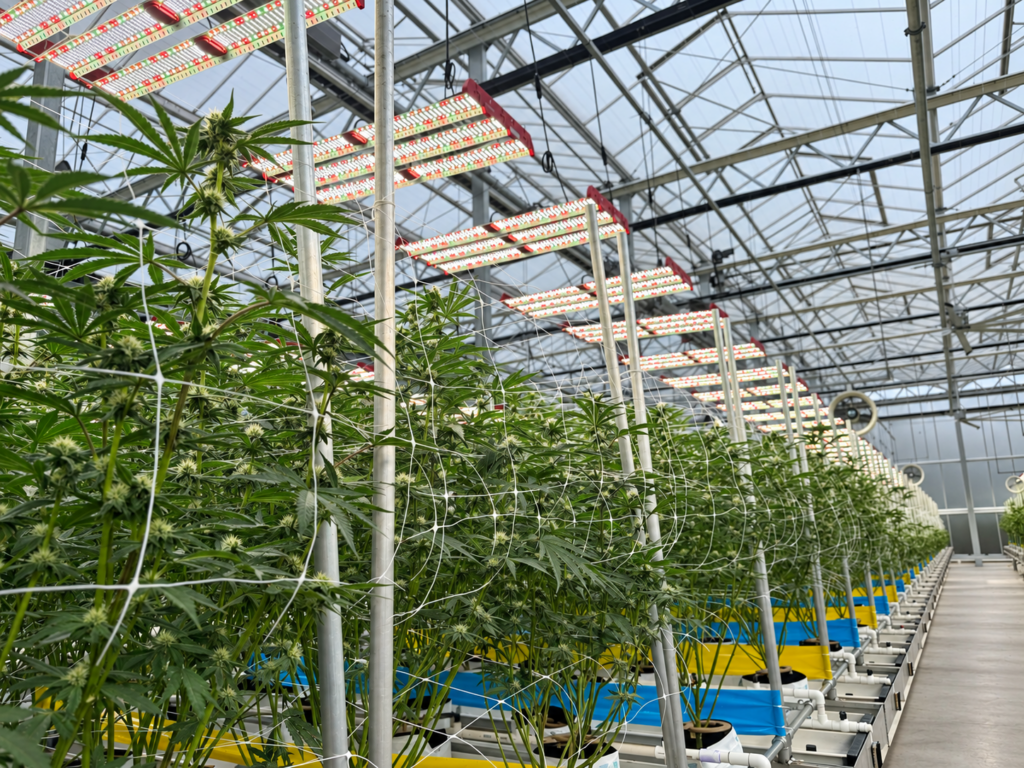
Across the Great Lakes and most of the Northeast, winter light gets thin enough that “supplemental” stops describing what the fixtures do. For a few months a year they carry most of the crop’s daily light, and a house that’s going to keep producing through that stretch has to be lit like it.
Count the light at the canopy
Daily Light Integral is the total photosynthetic light landing on a square meter over a day, in mol·m⁻²·d⁻¹. Most people start with the outdoor DLI maps, and those overstate what the crop actually gets.
Glazing, trusses, gutters, shade curtains, hanging equipment and the fixtures themselves all take a cut. Cornell Cooperative Extension puts greenhouse transmission at roughly 50 to 70% of outdoor light.¹ That’s a 40% swing in free light depending on where your house sits in the range, so if you’ve measured yours, use your number.
Cornell also points out that winter cloud cover across the northeastern U.S. regularly leaves crops short of the light they need for good photosynthesis.² Thin sun, filtered through a roof, on short days. That’s the starting point for a northern house in winter.
Same house, July and December
Think of the lights as filling a daily deficit. Take one greenhouse in Orange County, New York: 60% transmission, flowering cannabis with a 45 mol target on a 12-hour day, lit with fixtures at 2.8 µmol/J.
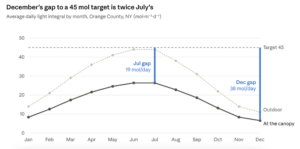
Approximate long-term monthly averages for Orange County, NY (estimate, not Copernicus data) · canopy = outdoor × 60% transmission
Canopy light never gets to 45 in this house, even at midsummer. The only question is how big the shortfall gets.
| July | December | |
|---|---|---|
| Gap to a 45 mol target (mol·m⁻²·d⁻¹) | 19 | 38 |
| Fixture PPFD to close it over 12 h (µmol·m⁻²·s⁻¹) | 430 | 890 |
| Power density (W/ft²) | 14 | 30 |
A house sized for July at 430 µmol needs about twice that in December. 890 µmol held across a 12-hour flower day is an indoor number, and 30 W/ft² is an indoor electrical load. Same crop, same footprint, same glass. The only thing that changed was the calendar.
The outdoor figures are approximate long-term monthly averages for Orange County. Plug in your own site data, your measured transmission and your real target before you size anything.
High-light crops make the gap expensive
Cannabis keeps responding to light long after most greenhouse crops have leveled off. A study in Frontiers in Plant Science grew cannabis under sunlight plus LEDs at average DLIs from about 18 to 52 mol·m⁻²·d⁻¹, and biomass and other growth measures kept climbing as total light went up.³ Indoor research says the same thing: through the intensities commercial rooms actually run, 1% more light gets you roughly 1% more yield.
That’s what makes the December shortfall a money problem. If the crop wants 45 and you deliver 30, you left something like a third of the harvest in the house, and you did it every winter cycle. Pick the target for your cultivars and your market, then size the lights to hit it in your worst month.
Size it for December
The design question for year-round production is how big the gap gets between canopy DLI and target DLI in your lowest-light production weeks. Fixture count, layout, intensity and power all follow from that number. Size it off a summer day and you’ll find out in January.
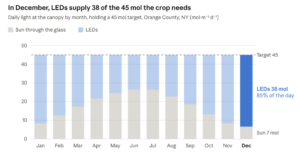
Same approximate Orange County, NY averages and 60% transmission as above · LEDs top up to 45 mol
Hold 45 DLI year-round and the lights run every month. What changes is how hard they work, and December sets the fixture count and the electrical service.
What goes into it:
- Historical outdoor DLI for the site, month by month
- Your house’s actual transmission
- Crop DLI and PPFD targets by stage
- Photoperiod
- Fixture output, efficacy and distribution
- Mounting height and what the structure can carry
- Electrical service
- Dimming and controls
Controls matter because a system sized for December is oversized for July. Dimming tied to a light sensor keeps you from paying for photons the sun is already delivering.
Overhead isn’t the only place to add capacity. In a tall, dense crop, running under canopy fixtures puts light on lower flower sites the top lights never reach, without hanging more weight from the trusses. This all adds to potential DLI, overall yield and quality.
Check the rebates too. Illinois, Ohio, Michigan, Connecticut and New Jersey are some of the strongest utility rebate markets for horticultural LEDs, and every one of them is a low-DLI winter state.
Greenhouse and indoor sit on the same line
It’s convenient to sort CEA into two bins, sun-lit greenhouses and electric-lit indoor rooms. Real facilities spread out between them. Some houses need a little help in winter. Some run their lights hard four or five months a year. A northern house growing a high-light crop needs capacity that looks a lot more like an indoor room than the word “supplemental” lets on.
At JumpLights we start from the facility: crop, location, structure, the light that actually reaches the canopy, the intensity you’re targeting and what you need to produce. That tells us how much the fixtures have to deliver, and we design to that number for the worst month on your calendar.
Sources
- Cornell Cooperative Extension, New York State Controlled Environment Agriculture.
- Cornell University, Greenhouse Lighting.
- Frontiers in Plant Science, Supplemental greenhouse lighting increased the water use efficiency, crop growth, and cutting production in Cannabis sativa.