April 3, 2026
The conversation around upgrading grow room lighting usually starts with HPS. Growers who have been running high-pressure sodium for years know the pitch by now: LEDs run cooler, use less electricity, and deliver more usable light per watt. That transition is well understood and well documented at this point.
What gets talked about less is the LED-to-LED retrofit. The assumption in a lot of operations is that once you have made the switch to LED, you are done. The hard decision is behind you. But the LED market has not stood still, and fixtures that were state-of-the-art five years ago are no longer representative of what current technology can deliver. For some growers, the right next move is not a first-time LED adoption but a second one, trading an older generation of LED equipment for something significantly better.
Knowing when that decision makes sense, and when it does not, requires looking honestly at what your current fixtures are actually delivering.
LED Technology Has Moved Faster Than Most Growers Realize
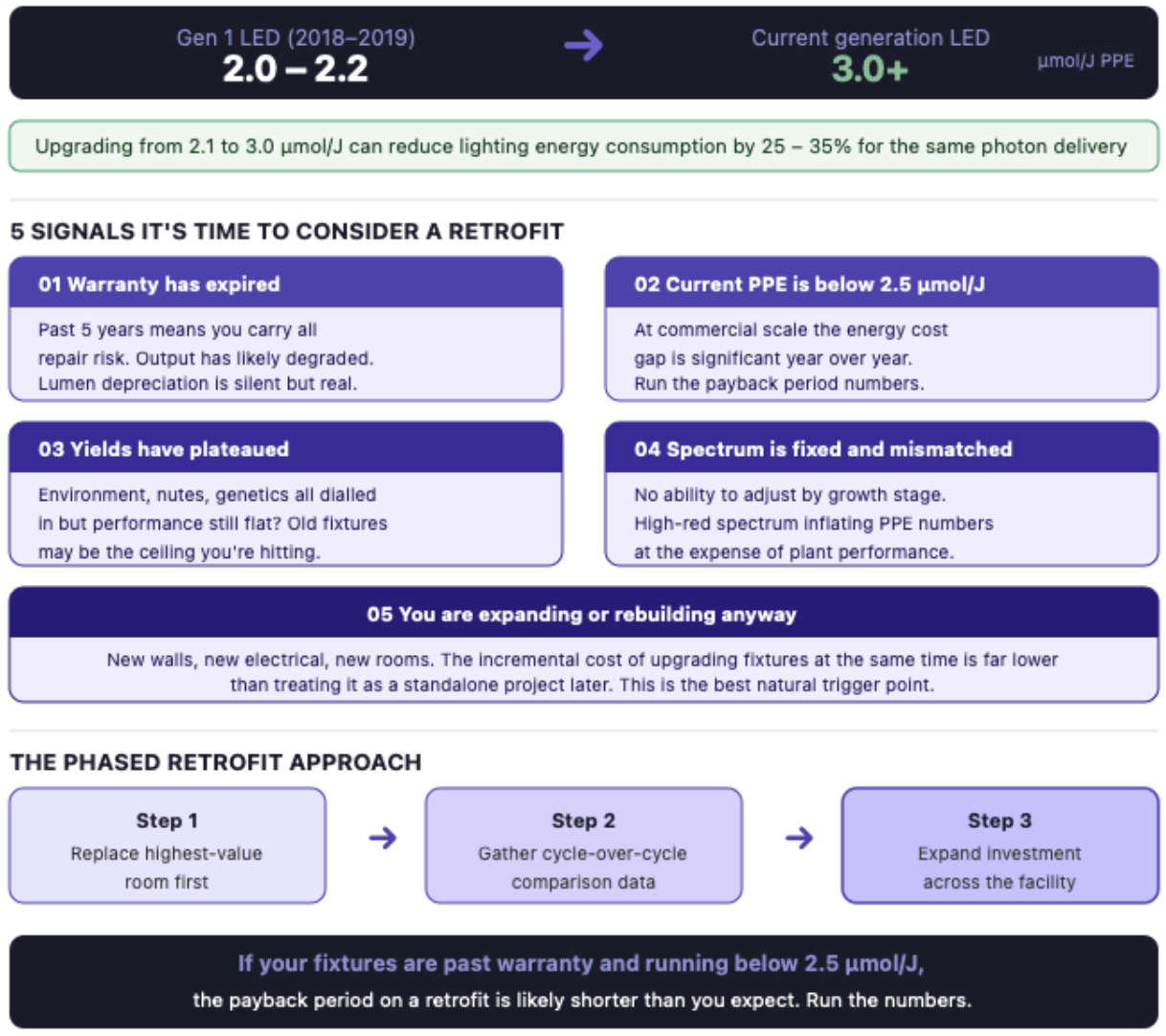
The efficiency gains in commercial LED technology over the past five to seven years have been substantial. Fixtures from 2018 or 2019 with a PPE of 2.0 to 2.2 µmol/J were considered strong performers at the time. Today, top-tier commercial fixtures are operating at 3.0 µmol/J and above. That is not a marginal improvement. At the scale of a commercial cannabis facility, the difference between a 2.1 µmol/J fixture and a 3.0 µmol/J fixture translates directly into either significantly lower electricity costs for the same light output, or significantly more light for the same electricity spend.
Spectrum design has also advanced. Early commercial LEDs often ran fixed, relatively simple spectrums that were effective but not particularly tunable. Current fixture designs offer broader spectral profiles, better uniformity across the canopy, and in many cases controllable output that allows growers to adjust intensity and spectrum by growth stage. If your existing LEDs are locked into a fixed spectrum that does not match what your program actually needs, that is a meaningful limitation regardless of how efficiently they run.
The Signs That a Retrofit Deserves a Serious Look
Not every operation with older LEDs needs to replace them. The decision depends on your specific situation, and it is worth being honest about the signals before committing to a capital expenditure. Here are the most common indicators that a retrofit is worth evaluating seriously.
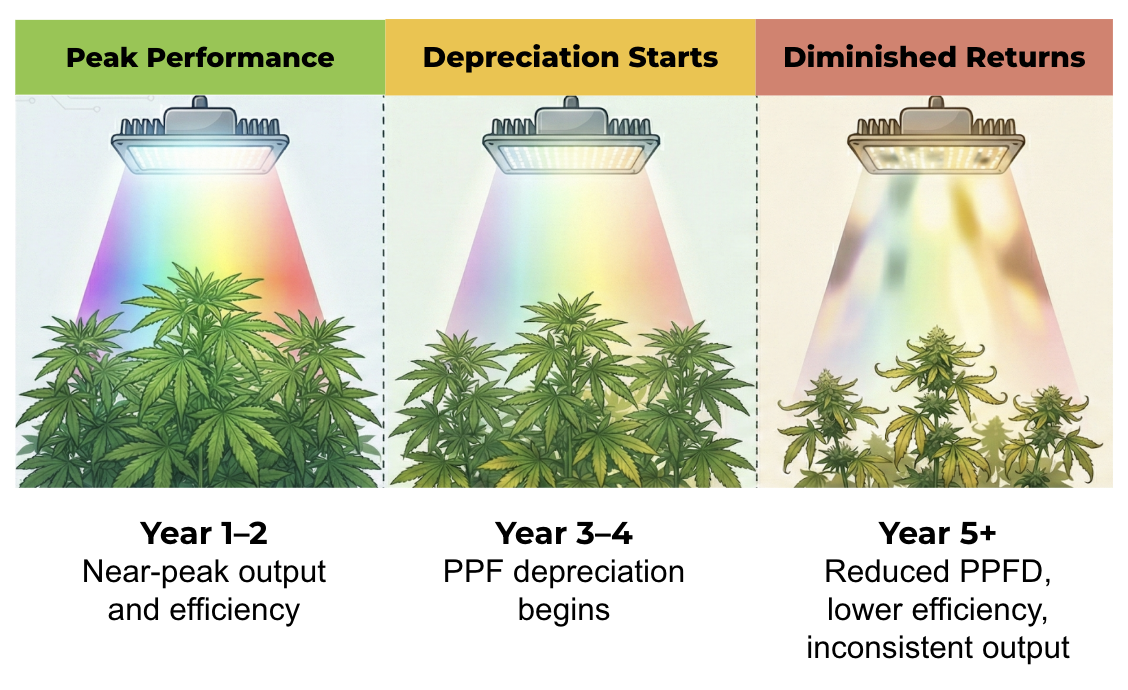
Your fixtures are approaching or past the end of their warranty. Most commercial LED fixtures carry a five-year warranty. When that window closes, you are carrying repair and replacement risk on your own. Older fixtures also experience gradual lumen depreciation over time, meaning the light output delivered on day one is not the same as what is delivered in year six or seven, even if the fixture appears to be functioning normally. If your lights are running past warranty and you are not sure how much output they have lost, that is worth investigating before the next cycle.
Your electricity costs are significant and your current PPE is below 2.5 µmol/J. Energy is typically one of the largest operating costs in a commercial cannabis facility. If you are running a large footprint on fixtures with a PPE of 2.0 or 2.2, upgrading to 2.8 or 3.0 µmol/J fixtures could reduce your lighting energy consumption by 25 to 35 percent for the same photon delivery. In a 10,000 square foot facility running lights for 18 hours a day, that is a material annual saving. Running the numbers against the cost of new fixtures will tell you whether the payback period justifies the investment.
Your yields or quality have plateaued despite optimizing other variables. If you have dialed in your environment, your fertigation, your genetics, and your canopy management, and you are still not hitting the performance benchmarks you expect, lighting is worth examining as a constraint. Older LED fixtures with lower output or uneven distribution may be the ceiling you are bumping against without realizing it. A PPFD map of your current setup will tell you whether intensity and uniformity are where they need to be.
Your spectrum is mismatched to your program. As the research on blue and green light continues to develop, it has become clearer that spectrum choice has real consequences for plant morphology, cannabinoid production, and yield. If your current fixtures run a high-red spectrum designed to maximize efficiency numbers rather than plant performance, or if you have no ability to adjust the spectrum by growth stage, you may be running a lighting program that is not optimized for the product you are trying to produce.
You are expanding or rebuilding anyway. A facility expansion or room renovation is a natural trigger point for evaluating lighting. If you are pulling walls or running new electrical anyway, the incremental cost of upgrading to current-generation fixtures at the same time is much lower than treating it as a standalone project later.
Get a FREE light plan + growing tips!
What to Look for in Replacement Fixtures
If you have decided a retrofit makes sense, the evaluation process matters. The LED market has matured but it has also gotten noisier, and not every fixture that claims top-tier performance actually delivers it. There are specific things worth verifying before committing to a purchase, including whether quoted PPE figures are measured at AC or DC, whether they are listed at full power or a reduced power setting, and whether the fixture’s certified DLC performance matches what marketing materials claim.
For an LED-to-LED retrofit, a few additional factors are worth weighing. First, does the new fixture actually deliver meaningfully better PPE and output, or is the improvement marginal? A jump from 2.1 to 2.4 µmol/J is real but modest. A jump from 2.1 to 3.0 is the kind of difference that changes your operating economics. Second, does the new fixture give you more control than your current one? The ability to dim, to adjust spectrum by stage, and to integrate with a central controller is a genuine operational advantage. Third, how does the new fixture’s footprint and light distribution compare to what you are replacing? Better average PPE from a fixture that creates hotspots and dead zones may not translate to better canopy performance.
The Case for a Phased Approach
For operations that are not ready or able to replace everything at once, a phased retrofit is a practical path. Replacing one room at a time allows you to run a genuine comparison, gather cycle-over-cycle data, and build the internal case for expanding the investment. It also spreads the capital cost over multiple budget cycles, which is often more manageable than a facility-wide replacement.
Starting with your highest-volume or highest-value rooms makes sense. If one room consistently outperforms because it runs newer fixtures, that data is persuasive and gives you a concrete business case for the rooms that follow.
How JumpLights Approaches LED-to-LED Transitions
We work with growers at every stage of their lighting journey, including those who already run LED and are evaluating what comes next. The ETS MAX series was built to represent what current LED technology can deliver for commercial cannabis, and we design every installation around the specific footprint, ceiling height, and performance targets of the facility rather than applying a generic layout.
Before recommending anything, we want to understand what your current setup is actually delivering. That means looking at your existing fixture specs, your canopy PPFD, your energy costs, and your cycle performance together. There are specific things worth verifying when evaluating any fixture, and we will walk through those with you so the comparison is honest rather than just a sales exercise.
If you are curious about how your current setup compares to what newer fixtures would deliver, the most useful starting point is a clear picture of what your canopy is receiving today. Get a free light plan and we will map your current performance and show you what an upgrade would actually change.
LED to LED Retrofit Webinar
JumpLights designs and manufactures high-efficiency LED grow lights for commercial cannabis and horticulture facilities. All products are engineered, assembled, and quality-tested in the USA.
Disclaimer
The content appearing on this webpage is for informational purposes only. JumpLights makes no representation or warranty of any kind, be it expressed or implied, as to the accuracy, completeness, or validity of the information. Any performance parameters, specific design features, or discussions of lighting fixtures or specs should not be inferred to represent what will be delivered for your specific project. Consult the JumpLights terms of service for more information.