April 9, 2026
Of all the environmental variables in a cannabis grow, humidity might be the one that punishes neglect most visibly. Get your lighting slightly wrong and you lose yield quietly over many weeks. Get your humidity wrong and you can lose an entire room to botrytis in days. It’s one of those things that experienced growers respect deeply and newer operations sometimes underestimate until they’ve learned the hard way.
The good news is that humidity control isn’t mysterious. It responds to clear principles, and once you understand what’s actually driving moisture levels in your facility (and why those levels need to be different at different stages of growth) managing it becomes much more systematic than it might initially seem.
Why Humidity Affects Cannabis So Directly
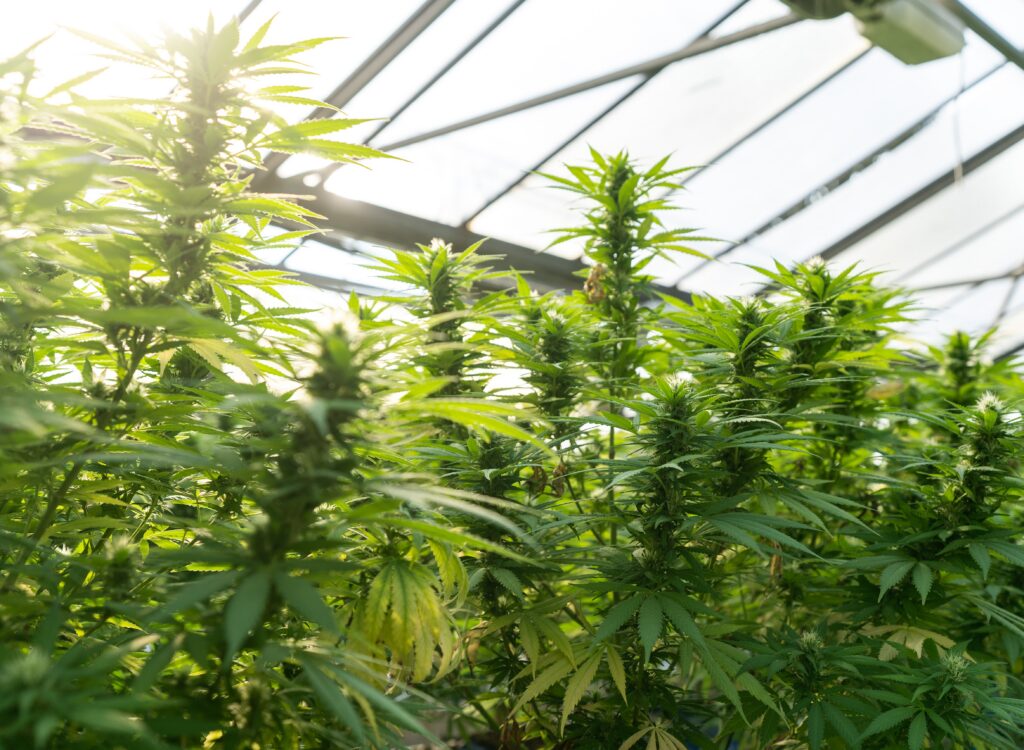
Cannabis transpires heavily. Through thousands of tiny stomata on its leaf surfaces, a healthy cannabis plant continuously releases water vapor into the surrounding air as part of its normal metabolic process. In a well-ventilated outdoor environment, that moisture disperses freely. In a sealed or semi-sealed indoor facility, it accumulates. And managing that accumulation is the central challenge of humidity control.
The relationship between humidity and plant health isn’t just about avoiding mold, though that’s certainly part of it. Humidity directly affects how efficiently plants can transpire, which in turn affects nutrient uptake, CO2 absorption, and overall growth rate.
Humidity’s role goes beyond simply preventing mold — it directly influences how efficiently a plant can move water and nutrients through its system. This is where Vapor Pressure Deficit (VPD) becomes useful. Rather than looking at humidity or temperature in isolation, VPD considers how much moisture the air can still absorb compared to how much it currently holds.
In practical terms, VPD reflects the “pull” the air exerts on moisture within the plant. When that pull is balanced, plants transpire at a steady rate, supporting consistent nutrient uptake and gas exchange. When it’s out of balance, plant processes begin to suffer.
When humidity is too high, transpiration slows. The air around the leaf is already saturated enough that the plant has nowhere to push moisture, which means it also struggles to draw nutrients up from the root zone. Growth stalls. And in dense canopies where air movement is limited, the conditions for fungal disease become ideal.
When humidity is too low, the opposite problem occurs. Plants transpire too aggressively, losing water faster than roots can replenish it. Leaves curl, tissue desiccates, and stressed plants become more vulnerable to pests and pathogens.
Target Ranges by Growth Stage
Cannabis doesn’t need the same humidity environment throughout its life cycle. Getting this right stage by stage is one of the more impactful things you can do for plant health and final flower quality.
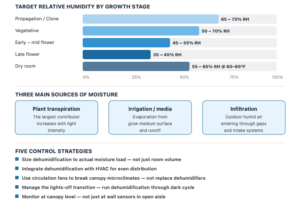
Propagation and early seedling: 65–70% relative humidity. Young plants have limited root systems and rely more heavily on foliar moisture absorption. Higher humidity supports early development and reduces the risk of early desiccation stress.
Vegetative growth: 50–70% RH, trending downward as plants mature and root systems develop. Plants at this stage are building canopy rapidly and transpiring heavily, so your dehumidification system will be working harder here than you might expect.
Early to mid flower (weeks 1–4): 45–55% RH. As flowering begins, reducing humidity starts to matter more. Developing bud sites create dense, layered tissue where moisture can become trapped. Getting humidity down before buds develop real mass is easier than trying to reduce it once the canopy is closed.
Late flower (weeks 5 through harvest): 35–45% RH. This is where humidity discipline pays its biggest dividends. Dense, mature buds have very limited airflow through their interior structure — a perfect environment for botrytis if moisture levels climb. Running leaner in the final weeks also encourages resin production as the plant responds to the drier environment, which can have positive effects on terpene and cannabinoid density.
Drying and curing: 55–65% RH in the dry room, at 60–65°F. The drying environment is its own topic, but it’s worth noting that humidity control doesn’t end at harvest — it continues to affect final product quality right through the cure.
The Main Drivers of Humidity in a Grow Room
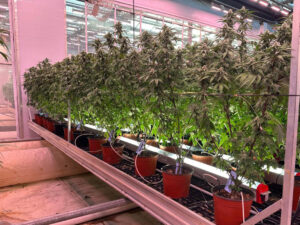
Before you can control humidity effectively, it helps to understand where it’s coming from. In most cannabis facilities, there are three primary sources:
Plant transpiration is typically the largest contributor, especially in a full canopy during late veg and early flower. A mature cannabis plant can transpire several liters of water per day. At commercial scale, the cumulative moisture load from transpiration alone is substantial.
Irrigation and media contribute moisture through evaporation from the growing medium surface, runoff, and any moisture that escapes the root zone. Tighter irrigation management — frequent smaller volumes rather than large infrequent feeds — reduces surface evaporation and gives you better control over the moisture in your space.
Infiltration from outside matters in facilities that aren’t well sealed. Warm, humid outdoor air entering through gaps in the building envelope, around HVAC penetrations, or through poorly managed intake systems can undermine all of your dehumidification efforts. This is especially relevant in summer months in humid climates, and it’s something that a surprising number of facilities don’t fully account for in their mechanical design.
Building an Effective Humidity Control Strategy
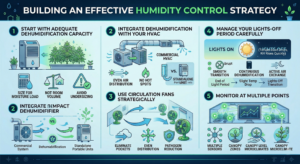
Start with adequate dehumidification capacity. This sounds obvious but it’s where many operations fall short. Dehumidifier sizing needs to be calculated against your actual moisture load — the number of plants, canopy size, transpiration rate, irrigation volume, and any infiltration — not just the room volume. Undersized dehumidification is one of the most common mechanical mistakes in commercial cannabis facility design, and it’s much more expensive to correct after the fact than to plan for correctly from the start.
Integrate dehumidification with your HVAC. Standalone portable dehumidifiers have their place in smaller operations, but commercial facilities benefit significantly from dehumidification capacity that’s integrated into the HVAC system. This allows more even distribution of conditioned air throughout the space and eliminates the localized hot spots that portable units can create around their exhaust.
Use circulation fans strategically. As we’ve discussed in the context of airflow management, air movement is one of your most effective tools for preventing the pockets of high humidity that form in dense canopy zones and low-circulation areas. Fans don’t remove moisture from the room — that’s the dehumidifier’s job — but they distribute moisture more evenly and help prevent the boundary layer conditions where fungal pathogens thrive.
Manage your lights-off period carefully. When lights go off, temperature drops, and the air’s capacity to hold moisture decreases. The same absolute humidity that was comfortable at lights-on can push relative humidity into dangerous territory within an hour of lights-off. Running a slight temperature drop at the end of the light period rather than an abrupt change and maintaining dehumidification through the dark cycle helps manage this transition. Some operators also run a brief period of active air exchange at the start of the dark cycle to remove accumulated moisture before temperatures fall.
Monitor at multiple points. A single sensor on the wall tells you what’s happening at that one location. Cannabis canopies create their own microclimates — temperature and humidity inside a dense canopy can be meaningfully different from readings taken at head height in the open aisle. Sensors placed at canopy level and within dense canopy zones give you a more accurate picture of what your plants are actually experiencing.
The Lighting Connection
One factor that doesn’t come up enough in humidity conversations is the direct relationship between your lighting and your moisture load. High-intensity lighting drives faster plant growth, which means faster transpiration and proportionally higher moisture output from the canopy. As you increase light intensity — particularly when upgrading from HPS or CMH to high-output LEDs — your humidity management system needs to scale with it.
HPS lighting also generates substantially more radiant heat than LED, and that heat gradient near the canopy affects local VPD in ways that can partially mask humidity problems at the canopy surface. When growers switch to LED and find they’re suddenly dealing with humidity issues they didn’t have before, it’s often because the HPS heat was artificially keeping canopy VPD in an acceptable range. The underlying humidity wasn’t better — it was just being compensated for. LED’s cooler operation exposes the actual humidity levels your dehumidification system needs to address.
Final Thoughts
Humidity control is one of those things that rewards consistency over heroics. Dramatic swings — high during lights-on, crashing at lights-off, spiking again when you open the room for maintenance — stress plants more than a slightly elevated stable level would. Building a system that maintains your target range reliably across the full 24-hour cycle, at every stage of growth, is the actual goal.
If you’re designing a new facility or troubleshooting humidity problems in an existing one, it’s worth evaluating your lighting and your environmental control systems together. The two are more connected than they’re often treated. Our team works with commercial growers to design lighting setups that account for the full environmental picture — not just what the spec sheet says.
Get a FREE light plan + growing tips!
JumpLights designs and manufactures high-efficiency LED grow lights for commercial cannabis and horticulture facilities. All products are engineered, assembled, and quality-tested in the USA.
Disclaimer
The content appearing on this webpage is for informational purposes only. JumpLights makes no representation or warranty of any kind, be it expressed or implied, as to the accuracy, completeness, or validity of the information. Any performance parameters, specific design features, or discussions of lighting fixtures or specs should not be inferred to represent what will be delivered for your specific project. Consult the JumpLights terms of service for more information.