April 9, 2026
When growers think about spectrum, red light tends to dominate the conversation. It drives flowering, is associated with bud development, and is the wavelength most closely linked to photosynthetic output in cannabis. Red gets the attention, and rightfully so.
But blue light plays a set of roles in cannabis cultivation that are just as important, and in some ways more nuanced. Getting your blue light dialed in is not just about checking a box on your spectrum. It shapes how your plants grow, how they look, and in certain respects, what ends up in the flower. Understanding what the research actually says about blue light helps you make better decisions about your lighting program rather than simply accepting whatever ratio a spec sheet happens to list.
What Blue Light Does in the Plant
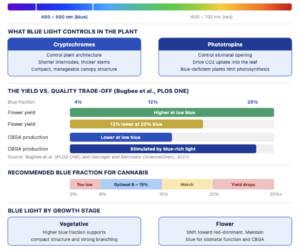
Blue light operates in the 400–500 nm wavelength range and is detected by two primary photoreceptor systems in plants: cryptochromes and phototropins (Briggs & Christie, 2002; Lin, 2000). These receptors govern a range of responses that are distinct from those driven by red light through phytochromes.
Cryptochromes regulate plant architecture, including stem elongation and leaf development. When sufficient blue light is present, plants tend to develop more compact, stocky structures with shorter internodal spacing and thicker stems (Folta & Childers, 2008). In the absence of adequate blue light, cannabis plants often stretch, producing taller and less efficient growth forms.
Phototropins control stomatal opening and phototropism. Blue light is a primary trigger for stomatal opening, enabling CO₂ uptake and supporting photosynthesis (Kinoshita et al., 2001). A deficiency in blue light can therefore reduce stomatal conductance and limit photosynthetic efficiency, even under high light intensity.
What the Research Shows
Recent cannabis-specific research has clarified how blue light affects both yield and quality.
A study published in PLOS ONE by Bugbee et al. examined the effects of varying blue photon fractions on cannabis yield and quality. Across three trials, the researchers observed a consistent linear trend: increasing blue light from 4% to 20% resulted in an approximate 12% reduction in dry flower yield (Bugbee et al., 2021). This suggests that while blue light is necessary, excessive levels may reduce overall biomass production.
Another study by Danziger and Bernstein (2021) found that blue light plays a key role in maintaining compact plant morphology and can stimulate the accumulation of CBGA, the precursor to major cannabinoids such as THC and CBD. Importantly, the response of individual cannabinoids was found to be cultivar-specific, indicating that spectral optimization must be tailored rather than generalized.
Additional research on cannabis photobiology indicates that green light may partially counteract blue light responses, including effects on stomatal behavior and secondary metabolite accumulation (Smith et al., 2017). This has implications for growers using broad-spectrum white LEDs with high green content.
The Morphology Argument for Blue Light
One of the most practical reasons to maintain an adequate blue fraction is structural control. Cannabis plants grown under sufficient blue light during vegetative stages develop tighter internodal spacing and stronger branching (Folta & Carvalho, 2015).
This architecture improves canopy uniformity, enhances light penetration, and supports more productive bud sites. In contrast, blue-deficient plants tend to stretch excessively, creating uneven canopies and underperforming lower growth.
These effects support a stage-specific lighting strategy. Many growers increase blue light during vegetative growth to control structure, then shift toward red-dominant spectra during flowering to maximize yield.
The Yield Versus Quality Trade-off
The findings from Bugbee et al. (2021) highlight a meaningful trade-off. Higher blue fractions tend to reduce yield but may enhance certain quality parameters, including cannabinoid precursor production. Lower blue fractions favor biomass accumulation but may compromise plant structure and secondary metabolite development.
The appropriate balance depends on production goals. Growers focused on maximum yield may prefer lower blue levels during flowering, while those prioritizing potency or chemical profile may benefit from moderately higher blue fractions, particularly in late flower stages.
Get a FREE light plan + growing tips!
What a Reasonable Blue Fraction Looks Like
Based on current research and commercial practice, a blue fraction in the range of approximately 8–15% of total PPFD is generally effective for cannabis cultivation (Bugbee et al., 2021; Danziger & Bernstein, 2021).
Below this range, plants may exhibit structural deficiencies associated with blue light deprivation. Above roughly 20%, diminishing returns in yield become increasingly evident.
The optimal level ultimately depends on cultivar, growth stage, environmental conditions (such as CO₂ concentration), and production priorities.
Final Thoughts
Blue light is not the sole determinant of successful cannabis cultivation, but it is a critical component of a well-designed lighting strategy. Its influence on plant architecture, stomatal function, and secondary metabolism makes it a powerful tool when used deliberately.
Advances in LED technology now allow growers to precisely control spectral composition across growth stages. Unlike traditional HPS lighting, which provides a fixed spectrum, modern LED systems enable dynamic optimization based on plant needs.
Understanding and applying these principles allows growers to move beyond default lighting setups and toward more intentional, data-driven cultivation practices.
References
- Briggs, W. R., & Christie, J. M. (2002). Phototropins 1 and 2: versatile plant blue-light receptors. Trends in Plant Science, 7(5), 204–210.
- Bugbee, B., et al. (2021). Effects of blue light on cannabis yield and quality. PLOS ONE.
- Danziger, N., & Bernstein, N. (2021). Light matters: Effect of light spectra on cannabis growth and cannabinoid profile. Industrial Crops and Products.
- Folta, K. M., & Childers, K. S. (2008). Light as a growth regulator: controlling plant biology with narrow-bandwidth solid-state lighting systems. HortScience, 43(7), 1957–1964.
- Folta, K. M., & Carvalho, S. D. (2015). Photoreceptors and control of horticultural plant traits. HortScience, 50(9), 1274–1280.
- Kinoshita, T., et al. (2001). Blue light regulates stomatal opening. Nature, 414, 656–660.
- Lin, C. (2000). Plant blue-light receptors. Trends in Plant Science, 5(8), 337–342.
- Smith, H. L., et al. (2017). The role of green light in plant responses. Plant, Cell & Environment, 40(10), 2134–2147.
JumpLights designs and manufactures high-efficiency LED grow lights for commercial cannabis and horticulture facilities. All products are engineered, assembled, and quality-tested in the USA.
Disclaimer
The content appearing on this webpage is for informational purposes only. JumpLights makes no representation or warranty of any kind, be it expressed or implied, as to the accuracy, completeness, or validity of the information. Any performance parameters, specific design features, or discussions of lighting fixtures or specs should not be inferred to represent what will be delivered for your specific project. Consult the JumpLights terms of service for more information.