March 16, 2026
There’s a number that gets thrown around a lot in growing: PPF, or photosynthetic photon flux. It tells you how much light a fixture produces in total and on paper, a higher number sounds like a better fixture.
Here’s the thing… total output doesn’t tell you much about what your plants are actually experiencing. A fixture that floods one corner of your canopy with 1,800 µmol/s while leaving another at 600 µmol/s has technically delivered a lot of light. It just hasn’t delivered it where it matters.
That gap — between how much light a fixture produces and how evenly it reaches your plants — is where a lot of growers quietly lose yield, consistency, and quality without knowing exactly why.
What Photon Output Actually Measures
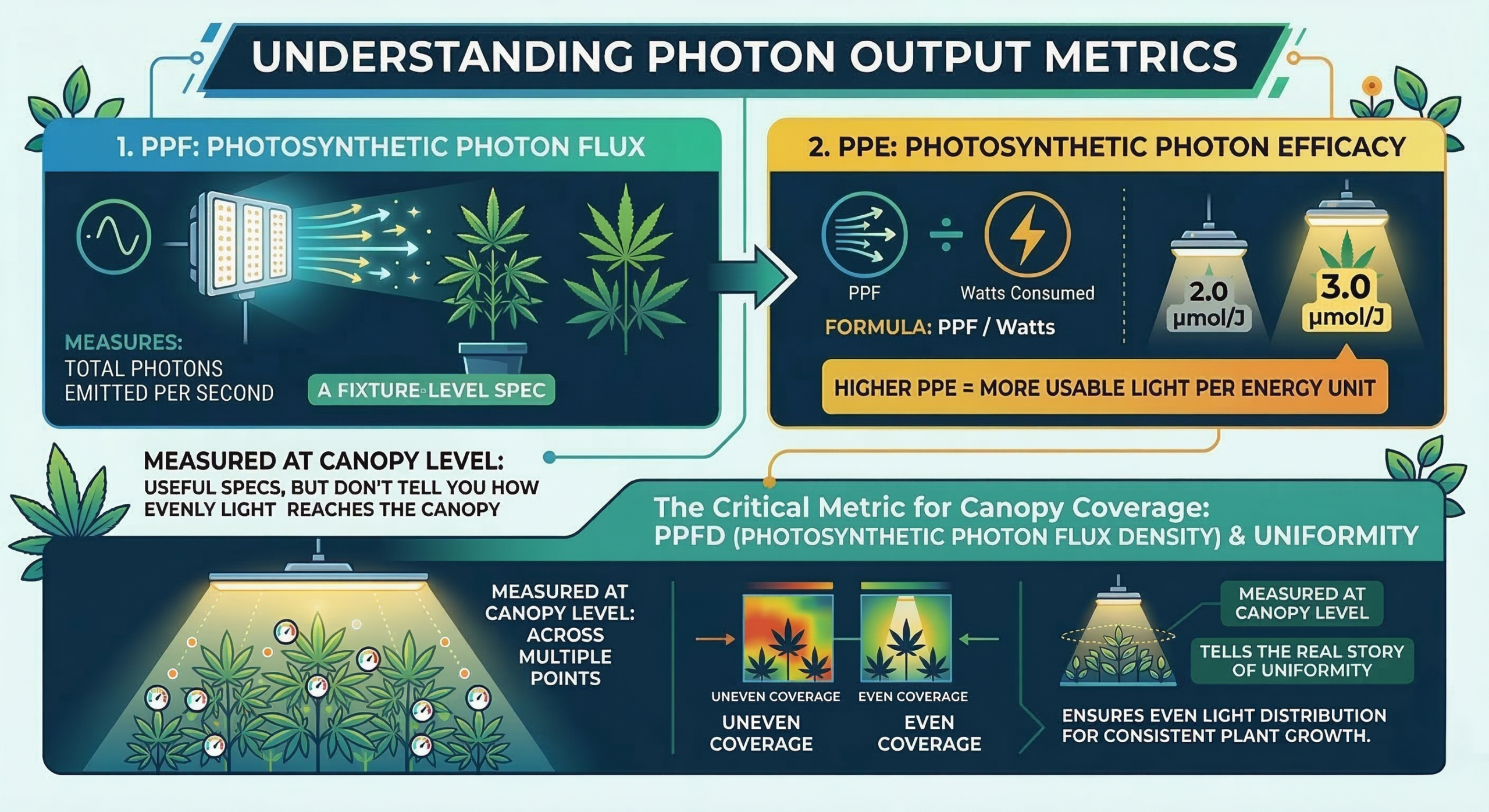
PPF measures the total number of photons a fixture emits per second within the wavelength range plants use for photosynthesis (400–700 nm). It’s measured in micromoles per second (µmol/s) and is a fixture-level spec — it tells you about the light source, not what happens after it leaves the fixture.
PPE (photosynthetic photon efficacy) takes that a step further by dividing PPF by the watts consumed, giving you a measure of efficiency in µmol/J. A higher PPE means you’re getting more usable light per unit of energy, which is why it’s one of the most meaningful numbers when comparing fixtures.
Both are useful specs. Neither one tells you whether your canopy is receiving that light evenly.
For that, you need to think about PPFD — photosynthetic photon flux density — measured at the canopy level, across multiple points in your room. That’s where uniformity becomes the real story.
The Canopy Doesn’t Care About Your Peak Reading
When growers measure PPFD, they often take a reading or two at the center of the canopy directly under the fixture, where the light is most intense. That number looks good. What’s happening two feet to the left — or in the row nearest the wall — often tells a very different story.
Cannabis plants are remarkably consistent about one thing: they respond to the light they’re actually receiving, not the light that’s theoretically available in the room. A plant sitting in a 600 µmol/s zone during flower is going to produce accordingly, even if the fixture overhead is rated for 1,500 µmol/s.
That’s the uniformity problem. Your average PPFD might look acceptable, but averages flatten out the variation. A room with one area hitting 1,400 µmol/s and another at 700 µmol/s might average out to something that sounds fine — while half your canopy is underperforming and the other half is flirting with light stress.
What Uneven Light Does to a Harvest
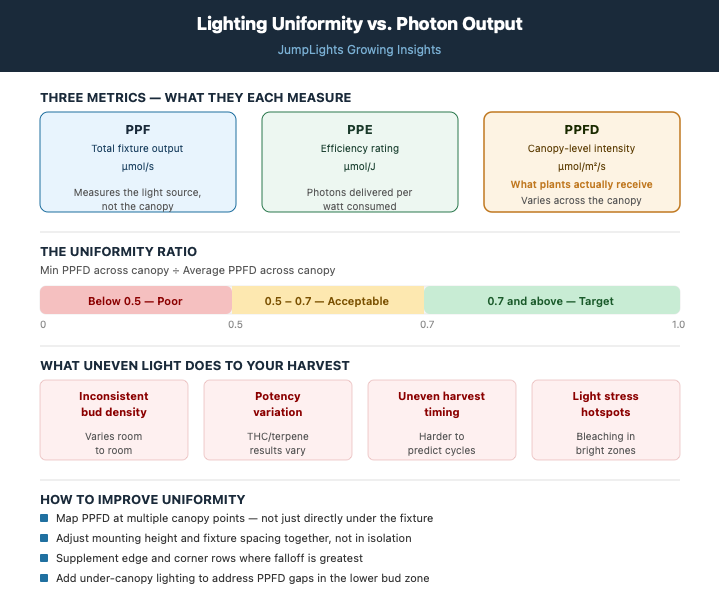
The effects of poor uniformity tend to show up in ways that are easy to misattribute. Inconsistent bud density across the canopy. Variation in potency or terpene profile from one section of the room to another. Harvest timing that’s harder to predict because different plants are at different stages of development.
These aren’t random outcomes. They’re the predictable result of plants that have been working with different inputs — the same genetics, the same nutrients, the same water, but genuinely different light environments.
For commercial operations, that inconsistency has real consequences. Testing results vary batch to batch. Sorting takes longer. Buyers notice when the product isn’t uniform. And because the root cause isn’t obvious, it’s easy to spend time chasing solutions in the wrong places — adjusting nutrients, changing water schedules, suspecting a pest issue — before landing on lighting as the culprit.
How to Think About Uniformity in Practice
A useful metric here is the uniformity ratio — the relationship between the minimum PPFD reading in a space and the average PPFD reading. A ratio of 0.7 or higher is generally considered good for cannabis cultivation. Below that, you’re likely to see meaningful variation in plant development across the canopy.
Getting there requires thinking about fixture placement, mounting height, and spacing together — not just maximizing output from a single point. A few practical considerations:
Coverage area matters as much as output. A high-PPF fixture mounted too high may spread light more evenly but reduce intensity at the canopy. Mounted too low, it creates a hot spot directly below and falls off sharply at the edges. Finding the right mounting height for your ceiling, your target PPFD, and your canopy layout is where the real design work happens.
Edge and corner rows almost always need attention. Light from a centrally-placed fixture naturally falls off toward the perimeter of the room. In commercial facilities, this means the rows nearest the walls frequently receive less light than interior rows — sometimes significantly less. Accounting for that in your fixture layout, or supplementing those areas, makes a measurable difference.
Under canopy lighting addresses a version of this problem. Dense canopies block light from reaching lower bud sites regardless of how even your overhead coverage is. Under canopy fixtures don’t replace the need for good overhead uniformity — they complement it by extending good light quality into the parts of the plant that overhead lights simply can’t reach effectively.
Output and Uniformity Aren’t in Opposition
It’s worth saying clearly: chasing uniformity doesn’t mean accepting lower output. The goal is to deliver the right PPFD — consistently — across as much of your canopy as possible. High-output fixtures designed with good beam angles and thoughtful layouts can achieve both.
What it does mean is that the fixture spec sheet alone isn’t enough information to design a good room. PPF and PPE tell you what a fixture is capable of. A well-designed light plan tells you what your plants will actually experience.
That’s a distinction we take seriously. When we work with a grower, the conversation isn’t just about which fixture has the highest output number. It’s about what the light distribution looks like across their specific footprint, where the gaps are, and how to close them.
Final Thoughts
Photon output is a starting point, not a finish line. The number on the spec sheet matters — but what happens between the fixture and the leaf is where yield and quality are actually determined.
If your canopy isn’t performing as consistently as you’d expect given your equipment, uniformity is worth investigating before you start changing anything else. A PPFD map of your facility, taken at multiple points across the canopy, will show you more than any single reading ever could.
If you’d like a second set of eyes on your lighting layout, our team can help you understand where your current setup is delivering and where it isn’t. Get a free light plan and we’ll build something around what your canopy actually needs.
JumpLights designs and manufactures high-efficiency LED grow lights for commercial cannabis and horticulture facilities. All products are engineered, assembled, and quality-tested in the USA.