April 10, 2026
Whether you’re building out your first indoor cannabis facility or optimizing an existing one, one of the most consequential decisions you’ll make is how you structure your canopy, and the lighting system that goes with it. Single-tier and multi-tier grows each have real advantages. The trick is knowing which one fits your operation, your space, and your business goals.
What We Mean by Single-Tier and Multi-Tier
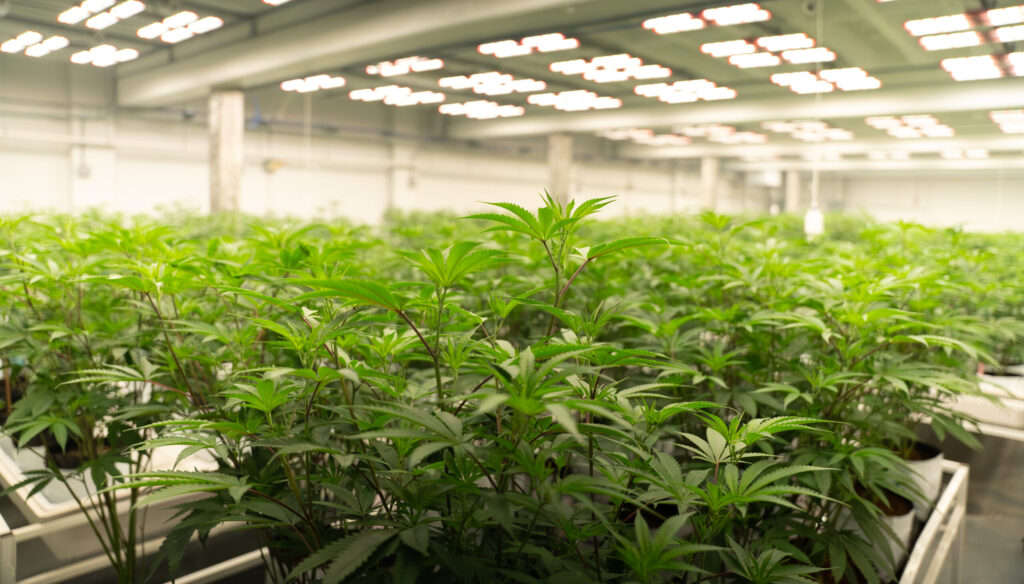
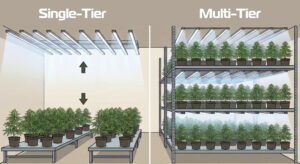
At its most basic, single-tier growing means one canopy level per room — plants on the floor or a single bench system, with lights mounted above. It’s the traditional model and still the dominant setup across the industry.
Multi-tier growing stacks canopy levels vertically (typically two to four layers) with dedicated lighting for each tier. Think of it as converting your room’s height into productive square footage.
Both approaches can produce exceptional cannabis. The difference is in how each performs given your facility’s constraints, your capital position, and your long-term production goals.
The Case for Single-Tier
Single-tier rooms are straightforward to design, build, and operate. That simplicity is genuinely valuable, especially early in a license or during a scale-up phase.
Where single-tier shines:
- Lower ceiling heights. If your facility tops out under 14 feet, stacking tiers becomes impractical or impossible. Single-tier is the right call.
- Lower upfront capital requirements. One canopy layer means fewer lights, simpler racking, and less HVAC complexity to manage at the start.
- Simpler compliance and auditing. Fewer zones, fewer variables. Plant tracking and batch management are easier to manage across a flat canopy structure.
- Flexibility in plant training. High-wire, ScrOG, and other canopy management techniques that need vertical space work naturally in single-tier environments.
- Genetics that benefit from longer veg cycles. When you have the room to let plants develop wider lateral structure, single-tier lets you take full advantage of that growth pattern.
Single-tier growing is also more forgiving for newer operations. The ability to walk through your room, adjust plants, and troubleshoot without navigating around stacked racks reduces the operational learning curve considerably.
Spotlight: ETS MAX Series for Single-Tier Grows
For single-tier setups, maximizing light intensity and uniformity across the canopy is critical.
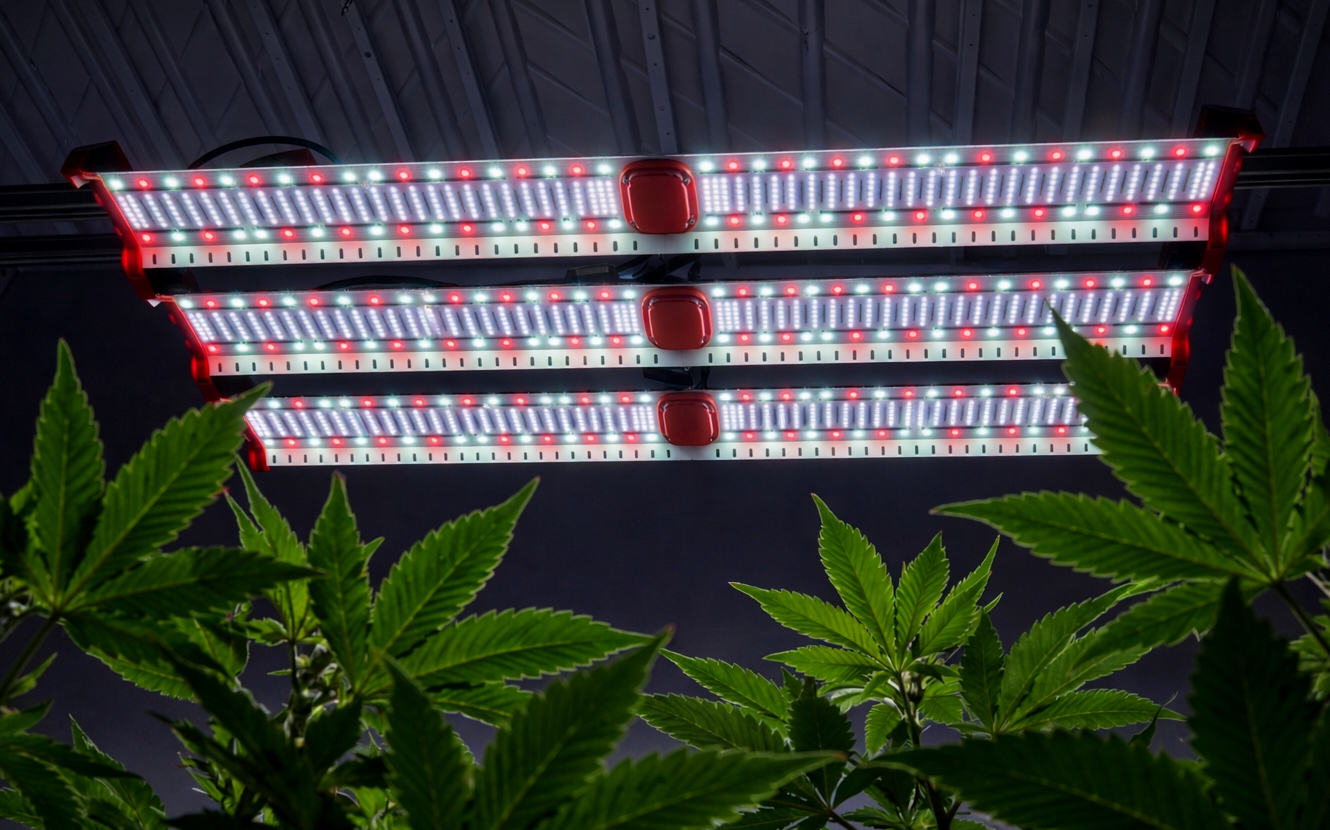
The JumpLights ETS MAX Series is built for high-output, over-canopy performance, delivering the photon density needed to drive yield while maintaining spectrum precision to protect flower quality.
The Case for Multi-Tier
Multi-tier growing is fundamentally about one thing: yield per square foot of facility footprint. If your facility space is limited, stacking canopy levels is one of the most powerful tools available to increase output without increasing your lease.
Where multi-tier makes sense:
- High cost-per-square-foot real estate. Urban markets, converted industrial spaces, and state-limited license holders with fixed square footage can double or triple production by going vertical.
- Facilities with high ceiling clearance. Buildings with 18-foot-plus ceilings are purpose-built for multi-tier. Leaving that vertical space unused is leaving yield on the table.
- Operations running clones or propagation at scale. Multi-tier structures excel for veg and prop rooms where canopy management is more uniform and lighting needs per tier are well-defined.
- Mature operations with strong SOPs. Multi-tier demands precision — in irrigation, environmental control, and plant uniformity. Operations with established systems in place are positioned to execute it well.
- Maximizing licensed canopy. In markets where your license caps your total canopy square footage, vertical production may be the only way to grow output without additional licensing.
The tradeoffs are real: higher upfront investment in racking, lighting, and HVAC, plus more complexity in daily operations. But for the right facility and the right operator, the ROI is difficult to match.
Lighting Is Where It Gets Complicated
You can build a multi-tier room and undermine the whole investment with the wrong lights. Multi-tier environments have unique lighting demands that standard over-canopy fixtures simply weren’t designed to handle.
In a stacked system, light from the tier above can’t penetrate the canopy below. Each tier needs its own dedicated light source, and those fixtures have to deliver in tight vertical clearances, often 24 to 36 inches between the top of the canopy and the bottom of the rack above it. That means low-profile form factors, precise photon distribution, and thermal management that doesn’t cook the plants below it.
Spotlight: The JumpLights Vert Series
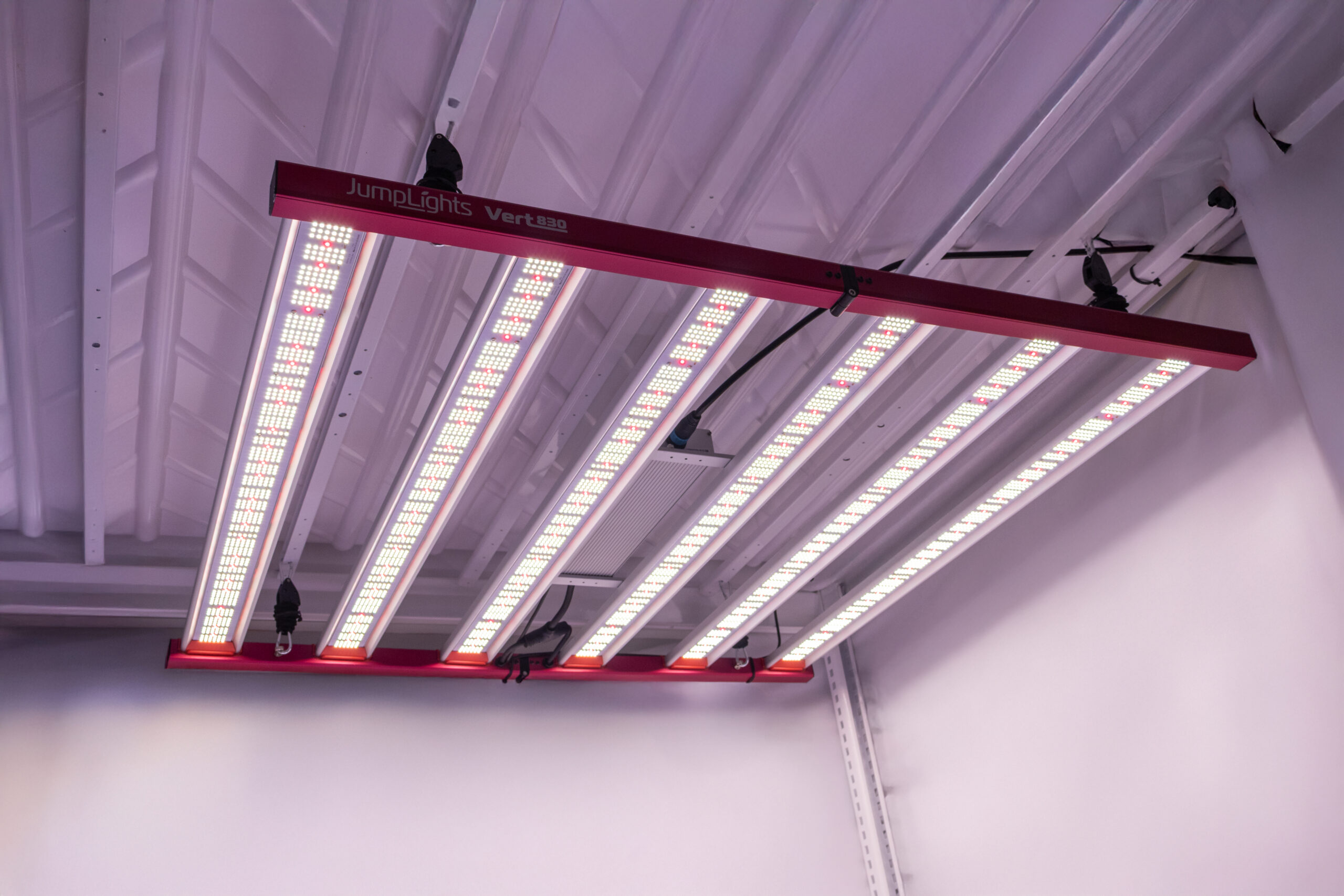
The new Vert Series was built specifically for multi-tier indoor cannabis environments and the spec reflects it.
VERT 830 — Multi-Tier Flower
The Vert 830 delivers 2,320 µmol/s PPF with up to 2.8 µmol/J efficiency (DC), providing high light output across a full 4×4 canopy footprint. Its balanced broad white spectrum is tuned to minimize photobleaching risk.Field-swappable light bars mean maintenance doesn’t require taking the rack offline.
VERT 420 — Multi-Tier Veg & Propagation
The Vert 420 brings 1,223 µmol/s PPF and up to 2.89 µmol/J efficiency (DC), purpose-built for high-density veg rooms and propagation. Fast, uniform vegetative growth across tiers means consistent plant sizing heading into flower, which is where multi-tier operations live or die on uniformity.
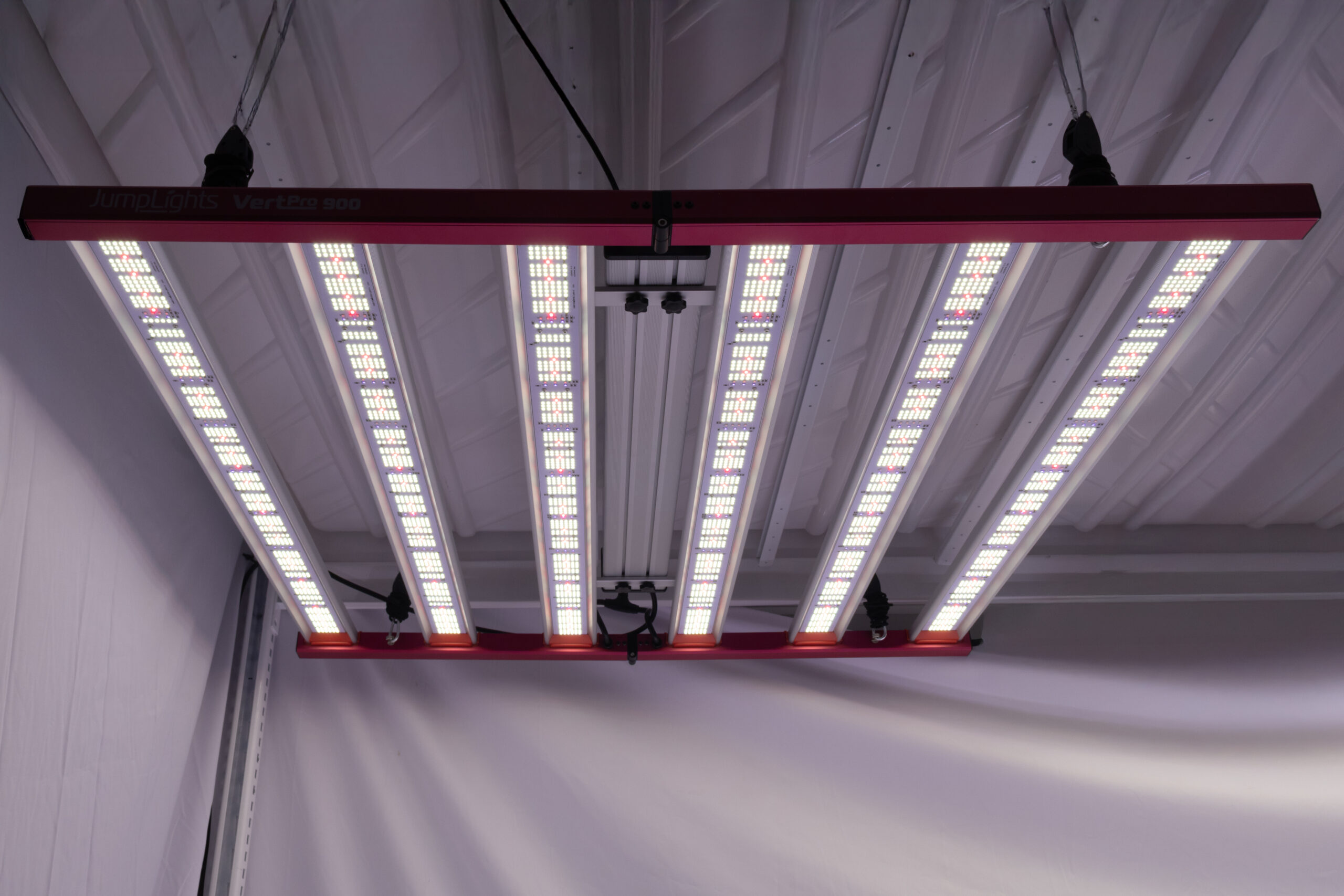
VERT PRO 900 — Multi-Tier Flower (Advanced Spectrum Control)
The Vert Pro 900 delivers ~2,400 µmol/s PPF with a multi-channel spectrum that includes UV-A and Far Red, giving growers precise control over plant responses throughout the flowering cycle. Designed for high-intensity, multi-tier environments, it enables strategies like phytochrome manipulation, canopy expansion, and targeted secondary metabolite production. Field-swappable light bars ensure maintenance can be handled quickly without taking racks offline, keeping your operation running at full output.
Thinking Through the Decision
There’s no universal right answer here. But there are a few questions worth working through:
What are your ceiling heights? This often settles the question before anything else does. Run the math on your usable vertical clearance, accounting for racking height, fixture depth, canopy height, and air circulation space between tiers.
What does your real estate cost? The economics of multi-tier improve dramatically as your cost per square foot increases. If you’re in a low-cost rural facility with room to expand, single-tier may pencil out better. If you’re in a premium urban market with a fixed footprint, going vertical almost always wins.
How mature are your operations? Multi-tier isn’t a starting point, it’s an optimization. If your cultivation team is still developing consistent SOPs, adding vertical complexity can amplify problems rather than solve them. Build your systems single-tier first, then consider expanding vertically once your production processes are dialed.
What’s your product strategy? High-quality, hand-finished flower that commands top-shelf premiums often rewards the space and attention of a single-tier approach. High-volume, consistently graded output may favor the throughput advantages of multi-tier.
The Bottom Line
Single-tier and multi-tier aren’t competitors, they’re tools. The right one depends on your facility, your market position, and where you are in your operation’s maturity.
What both approaches have in common is this: the quality of your lighting is non-negotiable. Whether you’re running one tier or four, getting the right photon output, spectrum, and fixture design for your specific environment is what separates good grows from great ones.
If you’re evaluating a multi-tier build or retrofit, the JumpLights Vert Series is worth a close look. And if you want help thinking through the lighting plan for your facility —single or multi-tier — our team is here for it.
Get a FREE light plan + growing tips!
JumpLights designs and manufactures high-efficiency LED grow lights for commercial cannabis and horticulture facilities. All products are engineered, assembled, and quality-tested in the USA.
Disclaimer
The content appearing on this webpage is for informational purposes only. JumpLights makes no representation or warranty of any kind, be it expressed or implied, as to the accuracy, completeness, or validity of the information. Any performance parameters, specific design features, or discussions of lighting fixtures or specs should not be inferred to represent what will be delivered for your specific project. Consult the JumpLights terms of service for more information.