July 28, 2026
When a grower pulls up two LED fixtures side by side, the first number they usually argue about is red percentage. It’s an easy spec to fixate on. Red photons are efficient to produce and brutally effective for photosynthesis, and cannabis eats them up in flower. So more red has to be better, right?
Not that simple. Red is one input in a spectrum, and the spectrum is one input in a room. There’s no single spectrum that wins everywhere. An indoor room pushing hard, a greenhouse riding sunlight, a temperamental cultivar, and an aggressive yield target all want something different. Knowing what each band of light actually does is what lets you pick a fixture that fits your grow instead of one that just has a big number on the sell sheet.
Blue: structure
Blue (roughly 400–500 nm) shapes the plant. It keeps growth compact, stems strong, internodes tight, and leaves developing the way you want. It also drives stomatal opening, so the plant manages water and gas exchange better. Get the blue right and you’ve built a plant that can carry heavy flower without stretching itself into trouble.
Green: penetration
Green used to get written off as the wavelength plants “reflect.” Turns out it does real work. Blue and red get absorbed up top; green drives deeper into the canopy and reaches the leaves the top photons never touch. In a dense room that’s the difference between a plant photosynthesizing top to bottom and one that’s only working up top. Green won’t replace your red or blue, but it carries usable light where they can’t reach.
Red: the engine
Red is the workhorse of flower. It’s absorbed about as efficiently as anything on the spectrum, and it’s responsible for most of the biomass you’re chasing. More red generally means faster flower development, more weight, and better efficacy per watt.
But red has a ceiling, and it’s tied to how hard you’re running. Push PPFD high with a red-heavy spectrum and some cultivars start bleaching at the top: pale, washed-out tips where the flower should be dense. Genetics, intensity, canopy temperature, and your overall environment all feed into it. If you’re running aggressive light levels, a lower-red spectrum buys you room before that becomes a problem, and you give up almost no photosynthetic punch to get it.
Far-red: more than Emerson
Far-red (700–750 nm) shows up in more fixtures every year. It contributes little to photosynthesis on its own, but it moves plant morphology and works with red through the Emerson Enhancement Effect. Used right, it helps light drive deeper, pushes canopy uniformity, and nudges flowering response. The key word is small. A touch of far-red rounds out a spectrum; it isn’t there to run the show.
Matching red percentage to the room
Cannabis responds to the whole spectrum, not one line on a spec sheet. Red does the heavy lifting in flower, but blue, green, and far-red each shape something the plant needs. Where you land on red comes down to how you grow.
A lower-red spectrum (30–40%) leans on more blue and green, gives you better morphology, cuts photobleaching risk, and holds up when you’re running extreme PPFD. A moderate spectrum (40–55%) is the indoor sweet spot for most commercial rooms: strong photosynthetic efficiency, strong flower, balanced growth. A high-red spectrum (70%+) makes the most sense in a greenhouse, where the sun already hands you plenty of blue and green and your supplemental light can just pour in efficient red to fill the gap.
Where the ETS MAX Series fits
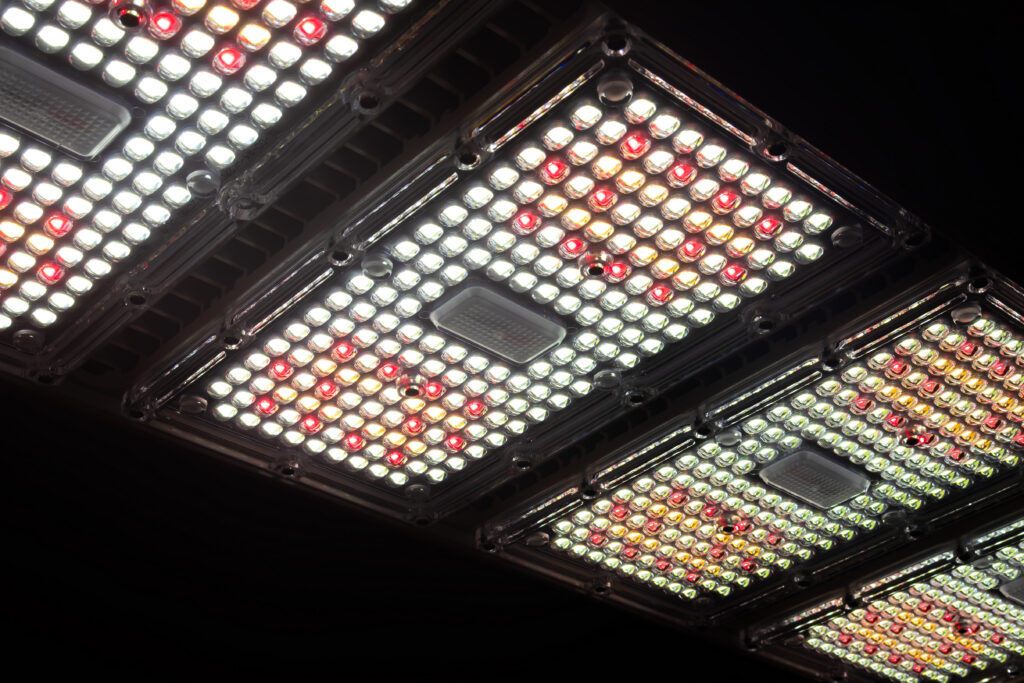
This is the thinking behind the JumpLights ETS MAX Series. Instead of forcing one spectrum onto every room, it comes in a few, because a greenhouse and a high-PPFD indoor flower room aren’t the same problem.
ETS MAX 4C — 41% red. For indoor rooms running very high intensity where photobleaching is the real risk. The lower red and broader balance give you headroom to push without cooking the tops
ETS MAX 4A — 48% red. A balanced indoor spectrum that keeps output high while keeping bleaching in check.
ETS MAX 5B — 57% red. The high-performance indoor option. Moderate red, dialed for efficiency and flower at once, up to 3,450 μmol/s with efficacy that holds its own for the spectrum.
ETS MAX 7A — 76% red. Built for the greenhouse. The sun’s already supplying blue and green, so this one leans hard into supplemental red, up to 3,900 μmol/s on infrastructure most greenhouses already have in place.
Bottom line
Picking a fixture isn’t a contest for the highest red number. The spectrum that wins is the one that matches your environment, your intensity, your genetics, and what you’re trying to produce. Get the spectrum, the intensity, the environmental control, the light distribution, and the genetics pulling together, and you’ve got a lighting strategy. Chase one spec in isolation and all you’ve got is a bright room.
The ETS MAX line was built around that idea: pick the spectrum for the room you actually have, indoor or greenhouse, and let the fixture work with your grow instead of against it.